With PSTA’s 40th anniversary upon us, we wanted to dive deeper than ever before into the fascinating history of transit in Pinellas County!
The story of public transit in Pinellas County is a long one, spanning as far back as 1885. However, in order to tell the full 139-year tale, we had to split it into three parts. So, strap in for a three-part odyssey as we venture back to when mass transit first began on our little isolated peninsula!
A map of Hillsborough County, Florida, 1882
(Courtesy of the University of South Florida)
Strictly speaking, Pinellas County isn’t very old. Formally established on January 1st, 1912, Pinellas became its own county after successfully seceding from Hillsborough County. The reason for the split? Citizens were growing fed up with the lack of paved roads on the peninsula, making transportation a major challenge, especially after rainstorms.
You could say that efforts to improve transportation have always been in the very fabric of Pinellas County. So, let’s take a deep drive back in time and discover how the pioneering public transit systems of the early 20th century would form the foundations of today’s Pinellas Suncoast Transit Authority!
Full Steam Ahead!
Mass transit first arrived in Pinellas County in the late 1880s thanks to the Orange Belt Railway, led by Russian Captain Peter Demens in 1885. The first train of the Orange Belt rumbled into an area near today’s Central Ave and Dr. M.L.K. Jr Street in the late 1880s, locally known at the time as Wardsville. The railway ran from Sanford, near Orlando, all the way to Wardsville, with notable stops in Tarpon Springs, Ozona, Dunedin, Clearwater, Bellair, Largo, and its terminus in soon-to-be St. Petersburg.
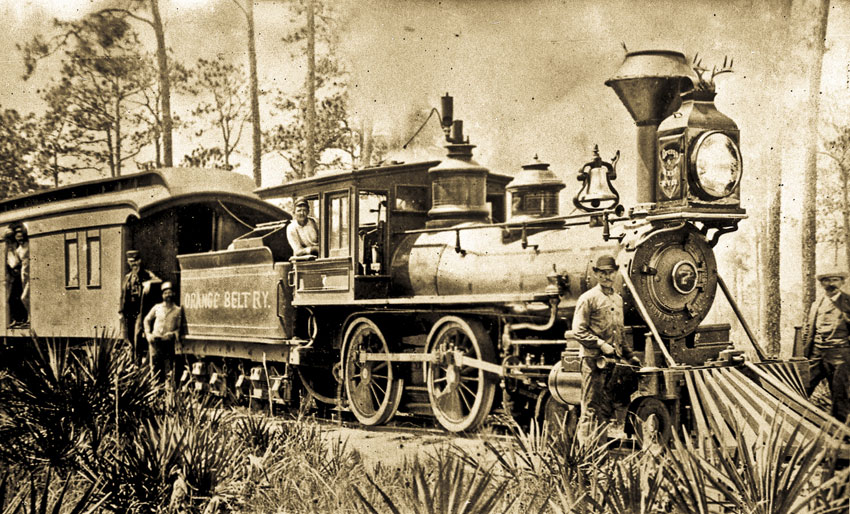
Orange Belt Railway train in Pinellas County, with President and General Manager Peter Demens standing on the right.
(Courtesy of Trains Magazine)
The train would thunder down Railroad Avenue, which we know as 1st Avenue South today. It would even travel a couple hundred yards into Tampa Bay on a wharf that’s now known as Demens Landing. Throughout its complicated life, the railway would bring many tourists and future residents to the area.
After a huge portion of the track was left abandoned in the 80s, the remnants of Pinellas’ Orange Belt Railway would become the Pinellas Trail, an impressive 47 miles of beautiful trails for hikers and cyclists to enjoy.
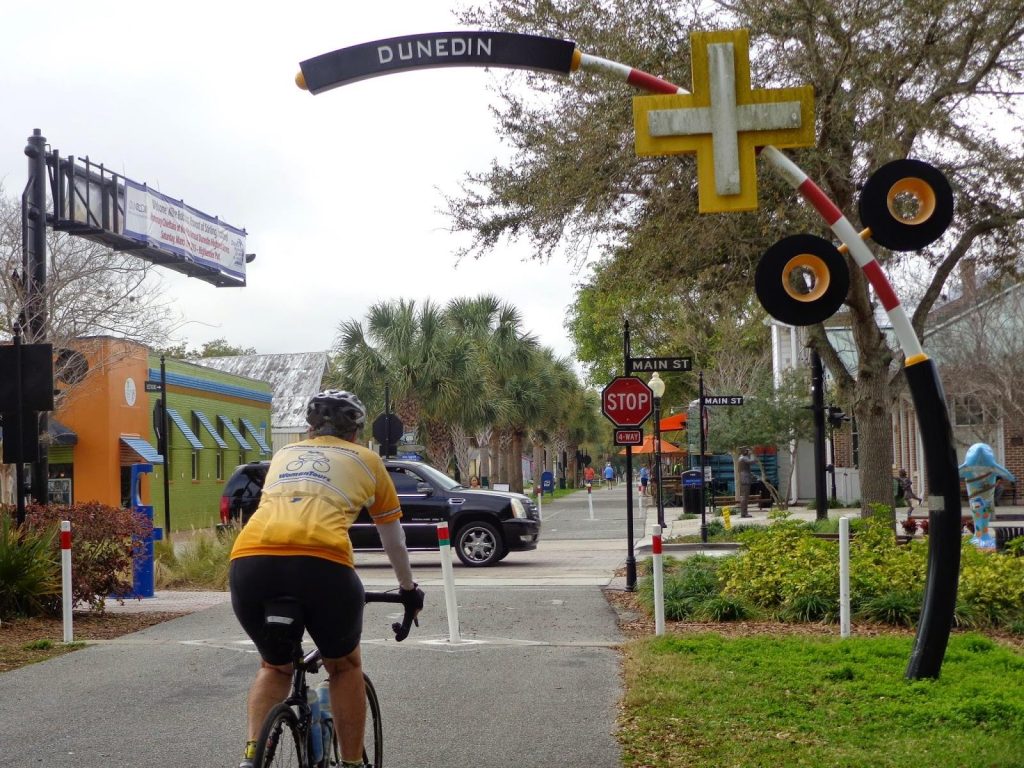
Cyclist riding beneath the railroad-inspired sign on the Dunedin portion of the Pinellas Trail.
(Courtesy of the Pinellas Trail Facebook Page)
Detroit native John C. Williams and Captain Peter Demens established St. Petersburg on June 8th, 1888, with a population of just 300. Despite its small size, it was the biggest area of population on the little peninsula considered West Hillsborough County at the time.
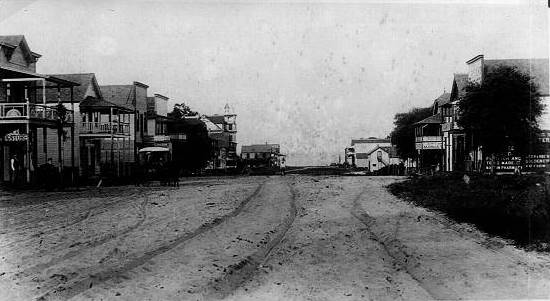
Central Avenue in newly founded St. Petersburg, 1895.
(PSTA Archives)
As the largest development in the soon-to-be Pinellas County, city-wide public transit began on what would one day become Central Avenue. While we may think of buses, trains, and commuter rails as examples of public transit today, the streetcar was king at the turn of the 20th century. In fact, we owe much of the development of St. Petersburg and Southern Pinellas County to the streetcar.
The Era of the Streetcar
The year was 1901, and on New Year’s Eve, Philadelphia native Frank Allston Davis would incorporate his newest entrepreneurial pursuit: St. Petersburg and Gulf Railway Company. You see, America was experiencing “Trolley Fever,” as rail-based and cable-hauled streetcars or trolleys were popping up in major cities around the country.
For example:
San Francisco’s cable cars in 1873; Scranton, Pennsylvania, “The Electric City” and their first electric streetcar line; Richman, Virginia’s streetcars of 1888; and Los Angeles’ 1872 electric streetcars that would soon become the longest electric tramway system in the world. Whether folks preferred to call them streetcars or trolleys, these charming open-air vehicles took the country by storm, and Frank A. Davis saw an opportunity for the burgeoning tourist town of St. Petersburg to reap the same benefits as the larger cities. After all, it was the sign of a “modern” city.
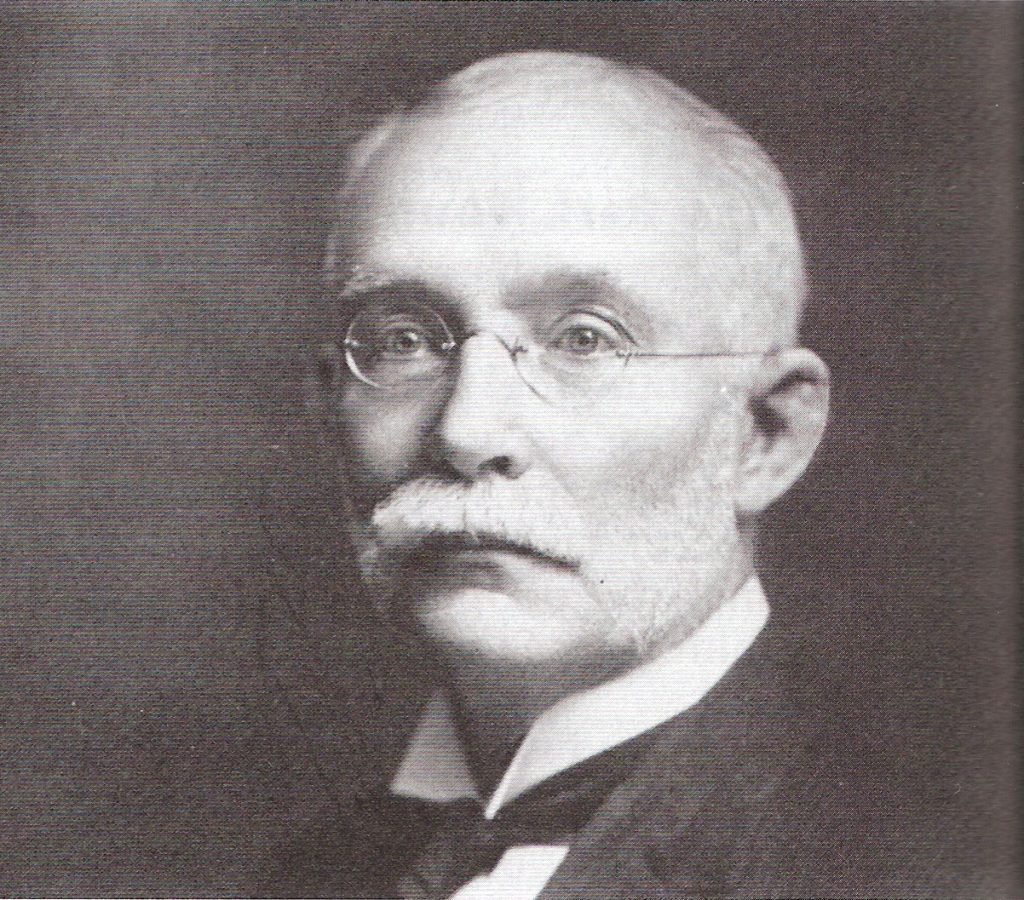
Frank Allston Davis
(Public Domain)
Real estate speculators were certainly interested in the idea as a selling point for new properties. So Davis turned to his fellow Philadelphian colleagues to raise the money necessary to begin construction on the trolley line. His friends had good reason to invest, too—Davis is credited for introducing electricity to St. Petersburg by founding the St. Petersburg Electric Light & Power Company in 1899. An electric trolley system seemed to be the perfect next step for Davis.
Among Davis’ investors were fellow Philadelphian Jacob Disston, brother of Hamilton Disston, whose contributions and investments aided in the development of Kissimmee, St. Cloud, Gulfport, Tarpon Springs, and the rapid growth of St. Petersburg. Jacob was eager to invest in a trolley line, as he wished for it to serve his property on the gulf. George Gandy was another big investor whose name is well-known among locals for the southern-most Gandy Bridge.
Next on the agenda was securing a franchise ordinance from the Hillsborough County Commissioners (remember, this was before Pinellas County was established). A franchise ordinance essentially allowed governments to grant exclusive privileges to private individuals or companies to be the sole providers of a good or service. However, obtaining one for his trolley line was fraught with contention and competition from another interurban line being considered between St. Petersburg and Tampa. Eventually, Davis got the terms he wanted after some revisions and squabbling, with the requirement that one mile of track be built within six months and an additional two and a half miles within 18 months.
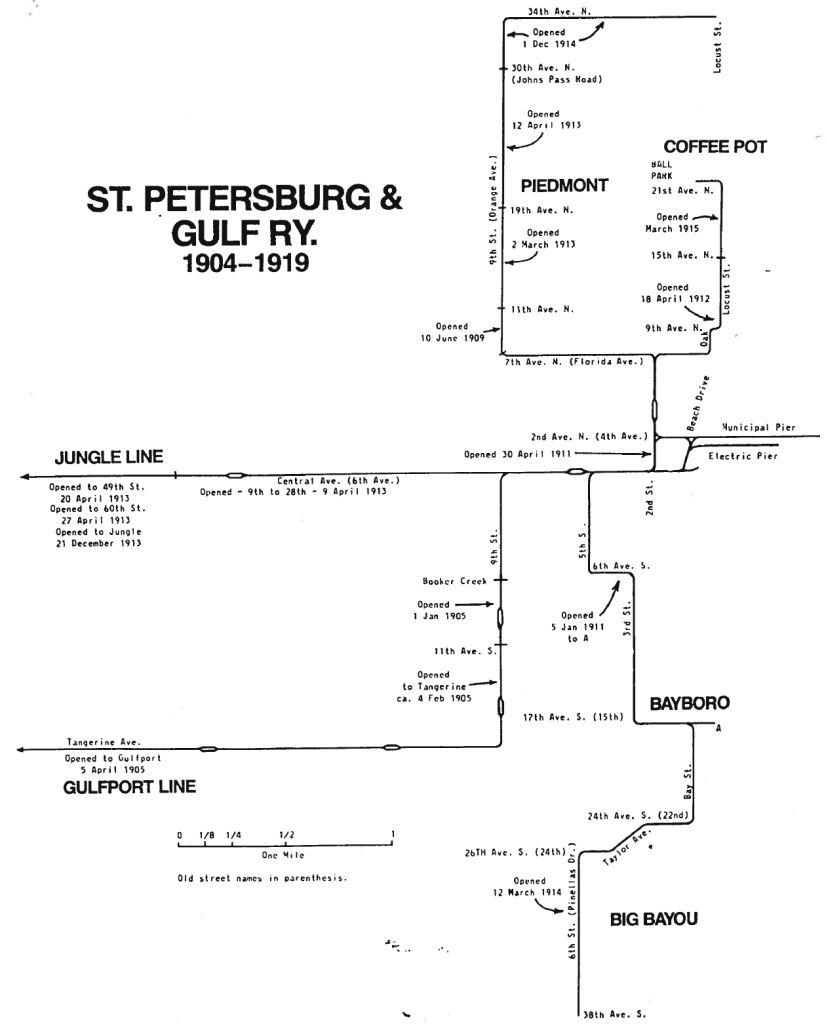
St. Petersburg & Gulf Railway trolley lines from 1904–1919.
(PSTA Archives)
The Central Avenue Line
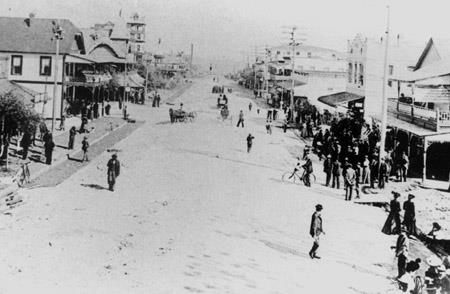
Central Avenue in 1901, before the Central Avenue Line was complete.
(PSTA Archives)
Construction began shortly on the first mile of rail, under the watchful eye of A. P. Weller, a stockholder and manager of St. Petersburg and Gulf Ry. Co. Securing the materials for the rails and a streetcar was difficult, but eventually, Weller prevailed. The first ever streetcar (known as car #1) in St. Petersburg would arrive on November 5th, 1902, shipped via railroad and likely pulled to the tracks by horse or mule. The car itself was bought second-hand, as were the rails and 500-volt DC generator used to power the trolley line.
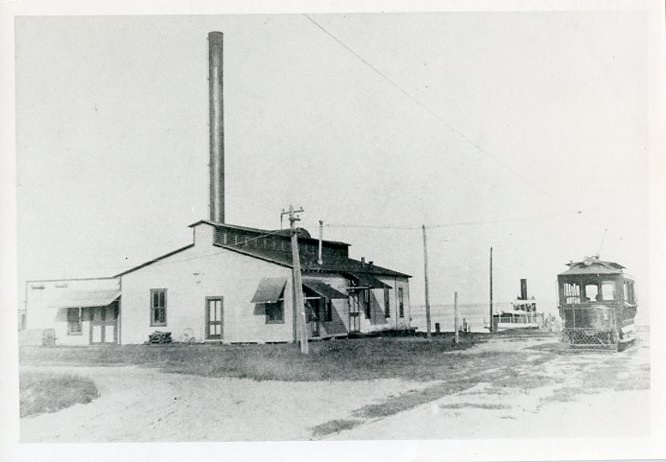
St. Petersburg’s first streetcar (car #1) at the start of Central Avenue next to its powerhouse in 1903.
(Courtesy of the St. Petersburg Museum of History)
Construction had finally begun on the track, but Davis was well behind schedule due to delays in procuring materials and building the powerhouse. They would not meet the six-month deadline, requiring an extension until March 1903. Despite the road bumps in construction, car #1 would make its first trek on Friday the 13th of February, 1903. To modern eyes, the loud squeal of worn wheels on the rusty track and resulting sparks would likely make us cringe. However, residents of St. Petersburg were enthralled by such a modern amenity in their city, gathering to watch and cheer as it rattled ten miles an hour down the small segment of track built so far.

A trolley on Central Avenue in 1905.
(PSTA Archives)
The future was coming to St. Petersburg, and its residents, entrepreneurs, and real estate investors alike saw endless opportunities for the city.
The Disston City Line. Uh… the Veteran City Line. Just kidding, it’s the Gulfport Line.
Although the track was still actively being laid, limited and free service had already begun for car #1. Real estate developers soon asked for extensions to their properties, especially in Disston City (founded by Hamilton Disston and later renamed “Gulfport”) to the southwest. And Davis would need to appease such a request, considering Jacob Disston was the trolley line’s primary investor. Davis obtained another franchise in 1903 to extend the line to Disston City, and the company ordered more second-hand cars from Washington and Baltimore, as well as unpowered trailer cars that could be towed by car #1.
The line to the developing Disston City would take passengers through thriving orange groves and pineapple plantations on its way to Disston Ave (49th Street) and Boca Ciega Bay. As with the Central Ave Line, service began quickly and would take passengers as far as the tracks were finished. During the construction of the line to Disston City, the franchise ordinance was amended to allow an extension to be built in 1904 that went from Booker Creek up Second Street to Florida Avenue (7th Avenue). This section would be operated as part of the Disston City Line.
The Disston City Line would finally be completed in April 1905. However, Disston City was also dead by 1905. Hamilton Disston’s beloved hotel on Boca Ciega Bay was damaged by severe weather damage twice and left abandoned for years, and the wharf next to it was rotting away.
Captain John F. Chase would take over development and change the name to Veteran City. See, Chase wanted to turn the area into a retirement community for Union Civil War veterans, a well-meaning idea not without its skeptics. Nonetheless, the line serving the new Veteran City was in service, and passengers were known to reach out the trolley windows to pick oranges as they clattered through the groves. Trolley crews would spearfish in Veteran City during their 15-minute layover, and fishermen would hang their catches on the car to show them off on their way back into St. Petersburg. What a sight that must have been
Veteran City, as Captain Chase envisioned it, would never materialize. By October 1910, votes would be cast at the Gulf Casino to choose the final name of “Gulfport” and officially incorporate it as a city. The trolley line would be known as the “Gulfport Line” from then on, and Gulfport citizens were grateful for reliable transportation to St. Peterburg, considering the complete lack of roads in the undeveloped area. Prior to the Gulfport Line, getting to St. Pete required either a boat, a treacherous journey through palmetto swamps by mule cart, or a miserable trek on foot trails.
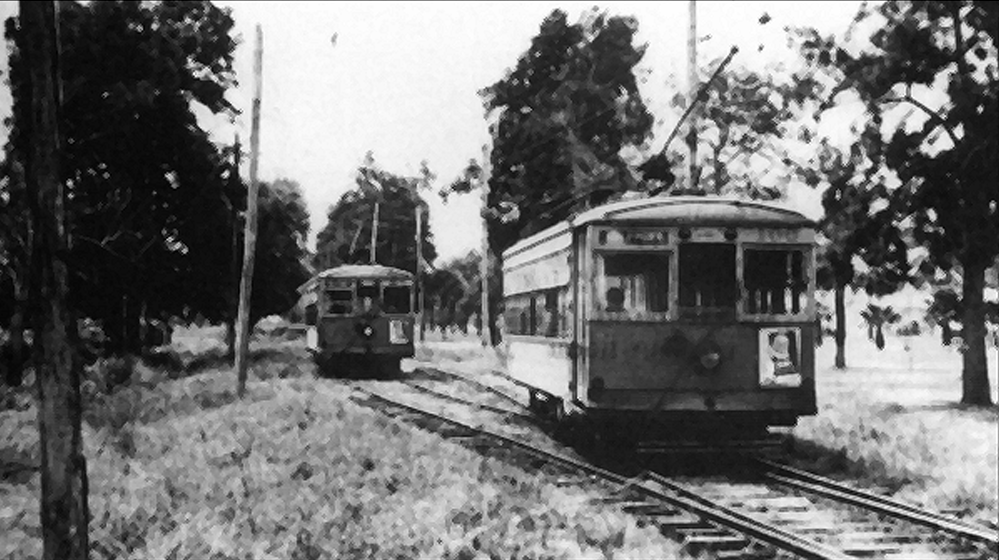
Trolleys entering the Gulfport Line switch, c. 1910.
(PSTA Archives)
Bayboro and Big Bayou
So far, the bulk of St. Petersburg’s growth had expanded northward, where land was easier to develop; to the east and to the south were low-lying, mosquito-infested swamps that would require much effort to develop. However, even further south of these swamps was precious high ground, and C. A. Harvey and Dr. H. A. Murphy had plans to dredge the harbor to fill in the lowlands. They organized Bayboro Investment Co. and started the complicated process of developing the area. Despite opposition from St. Petersburg and Tampa, as well as public disapproval and doubts, they managed to get approval for development, and work began.
But what would this new development matter without a streetcar line to serve it?
At first, Bayboro Company attempted to build and operate a trolley line themselves, even obtaining a franchise ordinance for a track to Pinellas Point on Tampa Bay in November 1906. Construction had begun, and gas motor cars were ordered, but the decision was soon made to have Davis and his St. Petersburg & Gulf Railways operate their electric line there instead.
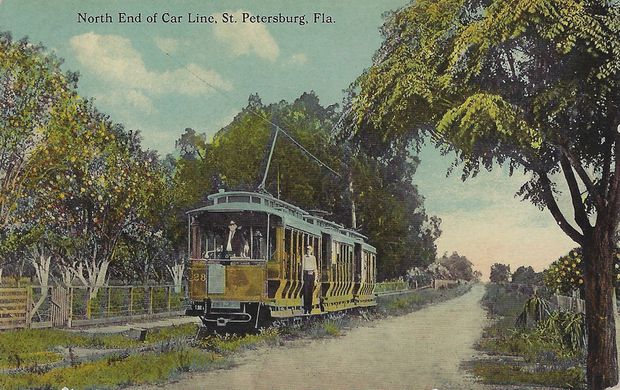
The north end of the trolley line that served the Southside of St. Petersburg to 38th Avenue South.
(Courtesy of Florida Memory)
And thus, the first trip made on the new line would occur on January 5th, 1911. The new Bayboro Line would run from Central Avenue to 15th Avenue (now 17th Avenue) and Bay Street.
With the success of Bayboro and the new trolley line, developments soon popped up even further south when real estate speculator R.R. Kennedy discovered more high ground and paid for a track extension from Bayboro to 38th Avenue S. near Big Bayou and Grandview Park. The line would be opened to the public on Thursday, March 12th, 1914, carrying more than 100 guests who owned property there.
Expansions to Northshore
By this point, Davis and St. Petersburg & Gulf Ry. Co. could languish a bit in their success. When another real estate investor or entrepreneur was paying for the track, all Davis’ company had to do was supply a streetcar and operate the line. The steady stream of nickel fares ($1.60 in today’s money) was plenty to cover the cost of the motorman and the electricity required to run the line.
Of course, that didn’t account for maintenance to the track or cars. Surely that wouldn’t become a problem in a few years…
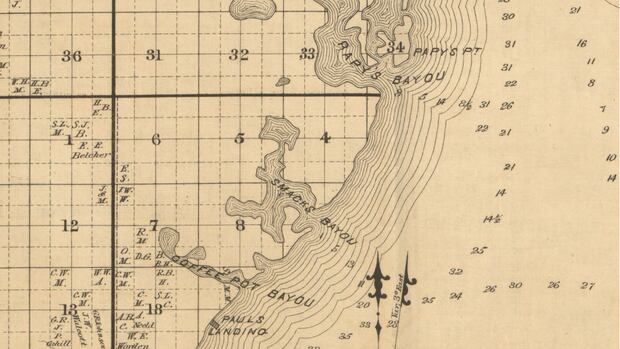
An 1882 map of the North Shore area.
(Courtesy of the University of South Florida)
Development north of downtown St. Petersburg and the Central Line was well underway. C. Perry Snell, a developer who would establish the Snell Isle area, organized the Bay Shore Company with the goal of taming the unmanageable palmetto pastures along the north shore. With homes quickly going up in the area, Snell and his business partner J.C. Hamlett paid for trolley tracks to serve Coffee Pot, Bay Shore, Bay View, and Bay Front. The line, referred to as “North Shore,” was operating down 22nd Ave N by April 1912 and was extended in 1915 to the newly-built baseball park at Coffee Pot Park, where the St. Louis Browns would conduct spring training in their 1914 season.
Another extension contract was created while the Coffee Pot and North Shore area was being developed and the trolley line was being laid. This line would travel up the west side of 9th Street (Dr. Martin Luther King Jr. Street N. today) to 34th Avenue North, serving what was considered the Piedmont area at the time.
Jungle Line
Among all of the early streetcar lines, the Jungle Line is perhaps the most famous. As the Central Line steadily crept to the west throughout the first decade of 1900, developer H. Walter Fuller had a vision for an area he called “The Jungle.” The Jungle is about two square miles on the west end of St. Petersburg, caged between the Pinellas Trail, 5th Avenue N., and Boca Ciega Shores. Today, the Jungle includes the neighborhoods of Jungle Terrace, Jungle Prada, and Azalea Homes, as well as Park Street North.
However, in 1907, the majority of this area was quite literally a jungle—simply a swath of undeveloped palmetto swamps and overall difficult terrain. For this reason, Fuller leaned into the “jungle” name, stating it was a taste of the “real tropics” as a marketing tactic to intrigue investors and tourists.

A postcard of “The Jungle” prior to its development.
(PSTA Archives)
Fuller firmly believed that the future of St. Petersburg’s success and the modernization Davis had heralded so far would depend on westward expansion. And, to Fuller, the Jungle was the next big thing for the city. His first goal was to extend the trolley line from bay to bay (Tampa Bay to Boca Ciega Bay), and Davis’ original investors from 1901 were ready to help fund the ambitious project. After securing the land from 9th Street to Boca Ciega Bay, construction began in October 1912, and the full line was finally completed in December 1913. It was marketed with the tagline, “Take Jungle Car and Help Yourself.”
Along the Jungle Line, Park Street would soon be host to many fine homes and, most importantly, fine entertainment. The convenience of the streetcar taking passengers right down the up-and-coming area attracted many winter tourists and wealthy locals alike. The Sunset Hotel would open in 1920 at the corner of Central Avenue and Park Street, and the Jungle Country Club Hotel and Golf Course would open in 1925 (the building is now part of Admiral Farragut Academy).
The decline in sales due to World War I would drive Fuller bankrupt, leaving his St. Petersburg enterprises to his son, Walter P. Fuller. And Walter was committed to continuing his father’s dreams for the Jungle.
In 1924, Walter built the “Jungle Prado” shopping center at Park Street and Elbow Lane (called the Jungle Prada Tavern today), named after the famous Prado Promenade in Havana. While it was originally named Jungle “Prado,” a St. Petersburg Times article listed it as “Prada” in 1941, and over the years, the name eventually became “Prada” everywhere. Spelling was quite loose back in the day, after all.
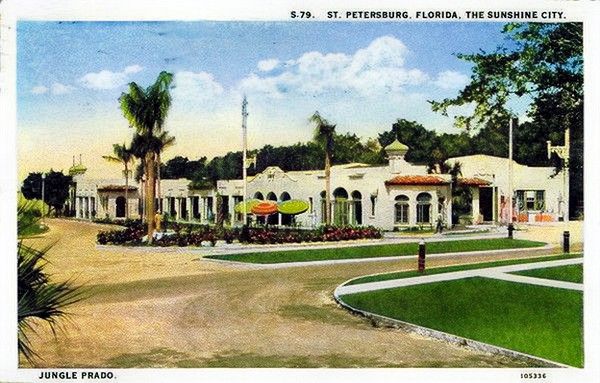
A postcard of the Jungle Prado, c. 1925.
(PSTA Archives)
The Jungle Prada also boasted a nightclub called The Gangplank, rumored to have played host to Duke Ellington, Babe Ruth, and even Al Capone. The Gangplank even had its own house band called “Earl Gresh and His Gangplank Orchestra.” And best of all, a recording of their 1925 hit “Help!” still exists today (click here to listen!).
With the convenience of the Jungle Line, the Jungle Prada was the premier shopping and entertainment destination of the time. There’s even local legend that The Gangplank housed a speakeasy during The Prohibition Era (1920–1933).
Without the Jungle Line, West St. Petersburg might have stayed a jungle for much longer!
Trolley Trouble

A streetcar traveling down Central Avenue, looking west from 5th Street, c. 1912.
(PSTA Archives)
World War I brought trouble to St. Petersburg and many of its businesses. Tourism declined while wages and electricity costs increased. St. Petersburg & Gulf Ry. had to spend most of their profits paying their employees, leaving very little for improvements and, most importantly of all, maintenance. Yes, track and car maintenance finally bit the company in the rear.
While the most obvious solution was raising the trolley fares, they legally couldn’t charge more—the state and city governments controlled fares with an iron fist. Davis and his partners had invested their own money into the trolley lines, and although Davis passed away in 1917, his company remained. However, without a viable way to increase income, there was only one option: declare bankruptcy in 1919, putting the entire trolley system up for auction.

A trolley in 1919.
(PSTA Archives)
The city of St. Petersburg and its founding fathers knew the collapse of the trolley lines would seriously harm tourism returning to the area after World War I concluded. In an extremely bold move for the time, the city chose to purchase the trolley system for its scrap value of $175,000 ($3,336,030 in today’s money), creating the St. Petersburg Municipal Transit System, later known as SPMTS.

The Jungle Trolley.
(PSTA Archives)
As Robert A. Stanton says in his 2006 book “Streetcar to the Jungle: Trolleys in the Streets of St. Petersburg, Florida,” an essential resource for this blog, “It was a bold move, but [105] years later, what remains of every streetcar system on this continent is publicly owned, and new ones are being built each year with government money.”
In many ways, St. Petersburg was already ahead of its time.
With the streetcar system under the city’s control, there was no longer a need to make a profit. However, there was now a trade-off—any improvement or major purchase must be voted on and approved. Only seven cars from the original company would remain, and the city began the process of acquiring new cars and rails.
Over the following decades, route extensions and improvements to trolleys and rails would occur under the city’s ownership. The city was growing rapidly, and although there were now more automobiles on the road after WWI, public transit through the trolley system was still the backbone of the city.
However, there was soon to be a new mode of transit in Pinellas: the bus.
Next Stop: The Bus
In the next installment of The History of Public Transit in Pinellas County, we’ll see how the bus’s introduction and the streetcar’s unfortunate fate would cause a complete paradigm shift in mass transit for our county.
The drama! The historical intrigue! You won’t want to miss Part 2 of this Deep(er) Drive into the past!
Click here to continue the story!
Sources
Buckley, James. Street Railways of St. Petersburg, Florida. Harold E. Cox, 1983.
Elftmann, Steve. The Jungle Country Club History Project, junglecountryclubhistoryproject.blogspot.com/p/blog-page.html.
Florida Memory, www.floridamemory.com/.
Kile, Monica. “125 Years of Light and Power in St. Petersburg.” I Love the Burg, 17 July 2024, ilovetheburg.com/125-years-of-power-and-light-part-two/.
Kile, Monica. “Remembering St. Pete’s Long-Lost Trolleys.” Northeast Journal | St. Petersburg, Florida Journal | Newspaper, 24 Jan. 2023, northeastjournal.org/remembering-st-petes-long-lost-trolleys/.
Lehman, Robert. “Streetcars in Tampa and St. Petersburg: A Photographic Essay.” Tampa Bay History, Digital Commons @ University of South Florida, 1997, digitalcommons.usf.edu/cgi/viewcontent.cgi?article=1442&context=tampabayhistory.
“Pinellas County Historical Background.” Pinellas County, Dec. 2008, pinellas.gov/wp-content/uploads/2021/11/PCHB.pdf.
Stanton, Robert A. Streetcar to the Jungle: Trolleys in the Streets of St. Petersburg, Florida. 2006.
Through the Transit Riders Advocacy Committee (TRAC), diverse members of the public who ride PSTA can represent their community and help improve PSTA’s services.
Welcome to our next installment of Behind the Wheel, a series dedicated to telling the unique, individual stories of PSTA employees, volunteers, and riders. For this month’s entry, we sat down with four members of PSTA’s Transit Riders Advocacy Committee, also known as TRAC.
A huge thank you to Mark O’Hara, Kim Rankine, Jay James, and Sean Schrader for taking time out of their day to share their story and love for TRAC and PSTA!
What is TRAC?
The Transit Riders Advocacy Committee, commonly referred to as “TRAC,” is a committee comprised of volunteers who provide insight and recommendations to the PSTA Board of Directors and its committees on operational and service concerns. Each TRAC member must ride PSTA at least two times a week and represent the diverse and geographic distribution of citizens in Pinellas County. In return for their service on TRAC, members receive a monthly bus pass.
TRAC currently consists of 12 transit users with the following representation:
- 9 county representatives:
- 2 representatives from North County
- 3 from Mid-County
- 3 from South County
- 1 from the beach communities
- 1 PSTA Access user
- 1 student
- 1 professional in the field of engineering, architecture, planning, legal business, finance, environmental, or similar
The stated purpose of PSTA’s TRAC is to:
- Provide knowledge of the system rider experience and ideas to improve operations and efficiency.
- Engage with staff during the planning process to ensure that the rider’s perspective is the foundation of agency plans and service.
- Promote and aid staff in better dissemination of general PSTA information.
- Act as a rider focus group for PSTA proposals and projects.
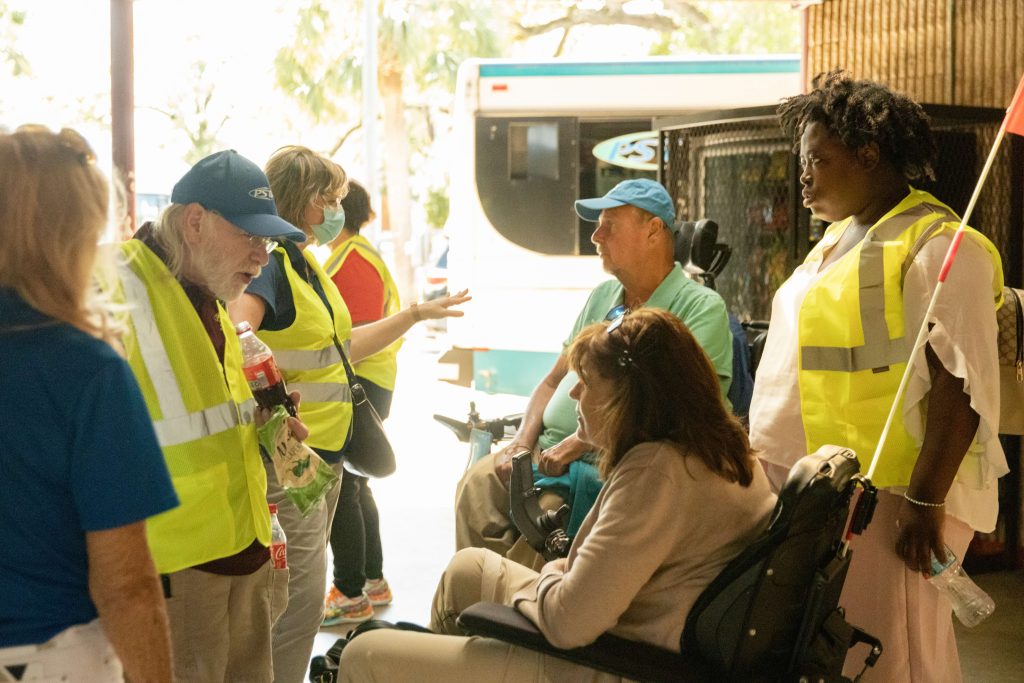
Pictured left to right: Missy Nevitt, Edwin Klump, Cassandra Borchers (former Chief Development Officer), Bob Bolles (former TRAC member), Jay James, and Gloria Lepik-Corrigan.
In short, TRAC allows the individuals who use PSTA’s service each day to have a voice in the decisions made by PSTA and the agency’s Board of Directors. While TRAC members are not required to have in-depth knowledge of transit, you will soon hear that some TRAC members inevitably become “transit nerds” as they learn more about the inner workings of PSTA and speak with our many subject-matter experts on complex topics and issues.
Now that you understand what TRAC is and the role the committee serves, let’s hear from four of our TRAC members. Each committee member was asked a few questions:
- When did you start using PSTA’s services?
- How did you first learn about TRAC, and what made you want to become a committee member?
- What does TRAC mean to you, and why is it so important?
- What’s your favorite part of being on TRAC?
- Who should join TRAC, and why should they join?
Mark O’Hara

Representing South County and serving as TRAC Chair, Mark O’Hara self-identifies as a transit nerd. But that wasn’t always the case! Mark first began regularly riding the bus in 2015, after a bad car accident convinced him to hang up the keys and take the bus instead. In fact, when he bought his house in 2016, he made sure his new home was near a bus line.
Mark first heard about TRAC through marketing efforts to attract new committee members via Facebook and public postings. Because he is extremely passionate about community service, he jumped on the opportunity to lend his voice and time to PSTA. After first serving as an alternate, he was eventually appointed as a permanent member and then elected chair. Although he had to step away for a bit in 2019, he was able to rejoin TRAC and has served on the committee for four years now.
“I thought joining TRAC would be a great chance for me to share my ideas about how PSTA could become a better transit agency. And it must have worked because PSTA won APTA’s Most Outstanding Agency in 2023!” Mark says.
But in all seriousness, Mark takes his role on TRAC very seriously.
“Anything that goes before the PSTA Board of Directors will also go before TRAC members for their input. Which I think is important, as TRAC members are weekly PSTA riders who actually use the service every day. We are the people out in the field, engaging with buses, operators, and fellow riders. So, we offer a valuable perspective on projects and decisions the agency makes.”
Mark’s favorite part of being a member of TRAC is having a direct impact on the future of PSTA. He also enjoys sharing the knowledge he gains with non-riders and fellow riders alike. With all that he’s learned about the inner workings of transit, he has become a fully-fledged transit nerd.
“Some people spend their Sunday morning looking at the paper; I spend my Sunday morning looking at proposed transit maps.”
When asked who should join TRAC and why, Mark says that transit riders who have a vision for growth in this county should apply. Recently, Whit Blanton from Forward Pinellas (Pinellas County Planning Organization) presented growth projections for the county and it is anticipated that the population may grow to over one million people in the next few years. Such population growth will put a major strain on already congested roadways, making public transit more important than ever.
“Viable public transit will be essential as our community grows. For that reason, we need people more involved in advocating for transit. I’m especially excited about the Community Bus Plan and am looking forward to revamping some of our routes to better serve our county!” Mark says.
Kim Rankine
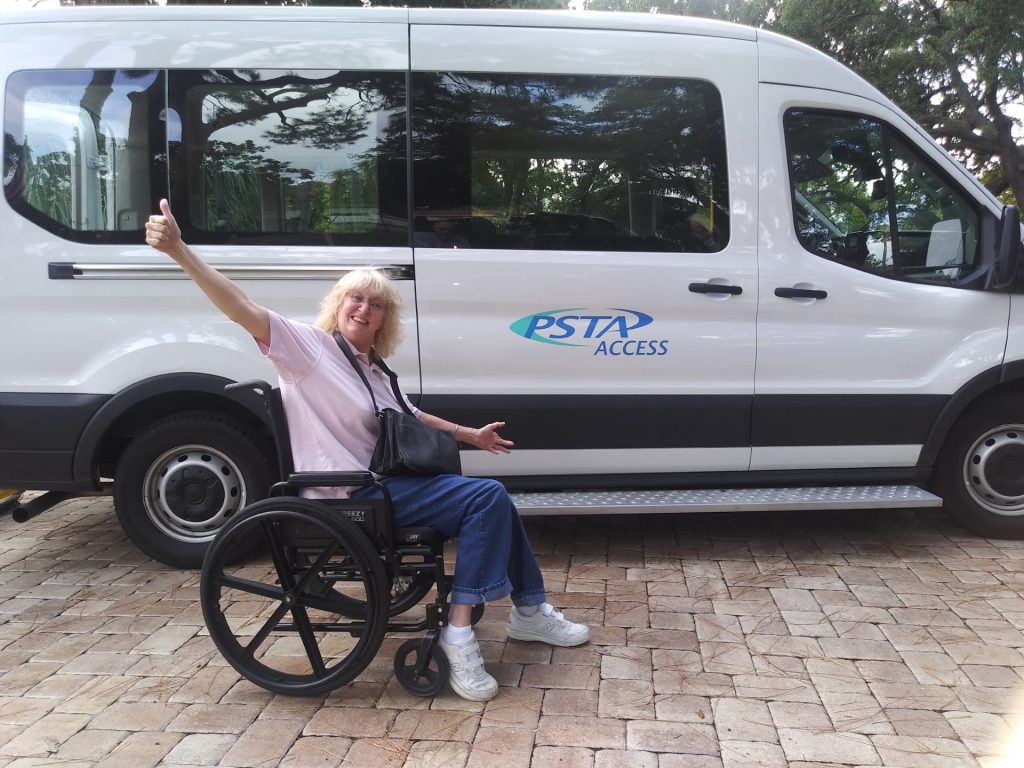
Kim Rankine, one of the founding members of TRAC, represents PSTA Access riders on the committee (learn more about PSTA Access here). She’s been using PSTA’s paratransit services since 2003, allowing her to see the huge growth in PSTA Access over the past twenty years. And she couldn’t help but rave about the freedom and independence Access gives her every single day.
“I always make sure I reserve my rides and love that I can track where my ride is through the app. Using PSTA Access allows me to have a normal, busy life like anyone else. I always joke that, without PSTA Access, I would be a mushroom in the closet, hahaha! I have a packed schedule thanks to Access,” Kim says.
When Kim first learned about TRAC in 2014, she was serving on the Committee to Advocate for Persons with Impairments (CAPI) at the time. Heather Sobush, Director of Planning, who we featured in our Women in Transit at PSTA blog a few months ago, attended the CAPI meeting to see if anyone was interested in joining the newly established TRAC committee.
“I was interested,” Kim recalls, “so she and I met for coffee, and she convinced me to be one of the founding members of the committee!”
During her time as a TRAC committee member, Kim has cherished the opportunity to be the voice for people with physical and mental challenges. And that desire to represent the community is evidenced by her participation in other committees. She currently also serves on the County Council for Persons with Disabilities and volunteers at the Dali Museum. It’s safe to say that Kim loves to keep herself busy and is passionate about helping PSTA continue improving its paratransit services.
“PSTA Access is such a vital service for me, and being able to represent fellow riders with disabilities is one of my favorite things about serving on TRAC,” Kim says. “I’m the biggest fan of Access, so I’m thankful for the opportunity to give insight into the needs of those with impairments. PSTA’s TRAC allows me to give a voice to my community and be more involved in decisions that affect us.”
In Kim’s opinion, everybody should consider joining TRAC because it gives riders the chance to be directly involved in the projects PSTA is working on. “Because,” Kim says, “how can we make it better if we’re not actively involved?”
Jay James

Jay James, in their own words, has been riding PSTA “since being in the womb.” Their ancestors have lived in St. Petersburg for over 100 years and have always taken public transit. So, it’s no surprise Jay would follow in their footsteps and become an avid transit rider themselves.
Jay has served on TRAC since 2019, representing mid-county citizens in Pinellas. They first learned about TRAC while between jobs. After calling PSTA to learn what discounted fare programs were available, Jay learned about TRAC and was immediately interested. Especially being a lifelong, multi-generational transit rider, they felt they could offer a unique and valuable perspective to PSTA.
“I applied and joined TRAC at the end of 2019. Unfortunately, I took a job out of town and had to leave for a little while, but I was able to rejoin TRAC again in February of 2020 and have been serving on the committee ever since,” Jay explains.
Bringing a lifetime of transit riding experience to the table, Jay felt that joining TRAC would give them an opportunity to encourage positive change at PSTA. “I wanted to give a voice to my community and TRAC allows me to do that,” Jay says.
Jay’s favorite part of being on TRAC is the chance to review plans and projects PSTA is working on, providing valuable feedback informed by their 41 years of riding transit. Each TRAC member’s insights and suggestions are essential to ensuring the decisions PSTA makes are in the best interest of every demographic or geographical area committee members represent. For Jay, being able to influence that change is the best part.
When asked who Jay thinks should join TRAC, they had this to say: “People who have a firm commitment to transit in our community and believe that transit is necessary for all of us. Those are the kinds of people who should join TRAC.”
With so many people just like Jay depending on public transit every day, there’s no question in Jay’s mind that transit is an essential service to all communities. Jay hopes that more people, both citizens and elected officials, will fight for transit, not against it.
Sean Schrader

It was towards the end of Sean Schrader’s junior year of high school that he became interested in trying out public transit. Although he was already driving, he was keenly aware of the many benefits of taking the bus—not only is transit better for the environment, but it helps ease traffic by getting more single vehicles off the road. Although Sean admits he loves driving, he made the conscious choice to take the bus instead. This one choice would ultimately lead him to joining TRAC, where he would represent students in Pinellas County.
Sean is certainly no stranger to public service. He has served as Secretary on the Clearwater Neighborhoods Coalition executive board, a student ambassador for Feeding Tampa Bay, a member of the Clearwater Charter Review Committee… and the list goes on and on. But it was during his time as a student at the University of South Florida, where he would serve as student governor, that he chose to get involved with PSTA on behalf of USF students.
“One of the biggest challenges that students shared with me was issues getting around the community due to a lack of transportation or access to a car,” Sean recalls. “It’s something you take for granted every day. Having access to those transportation options is really important, so I reached out to PSTA to discuss how we could make more students aware of the different programs and resources being offered.”
Sean’s passion and interest made him an obvious candidate for TRAC, as there was not yet a committee member to represent the concerns of students. In May of 2023, Sean would join TRAC and begin learning everything he could about PSTA and the programs on offer.
“PSTA is an essential service,” Sean says. “It’s not one of those things that are used every once in a while; it is something that many, many people depend on on a daily basis. The decisions being made don’t just fall out of the sky; they’re being determined by folks who use these services every day, know what they’re like, know what works and what doesn’t, and how we can move forward effectively. I think that involvement really shows the commitment of PSTA to be informed decision-makers that do what’s in the best interest of the members of our community.”
Sean’s favorite part about serving on TRAC is getting to learn from subject-matter experts who provide so much in-depth information for a deeper level of understanding. While he does not see himself as a transit expert, he loves learning about PSTA’s services and programs so he can help fellow students better understand how they can utilize public transit. After all, thanks to the Universal Pass Program (UPASS), Pinellas County School students and college students are able to ride PSTA for free!
“Unfortunately, there is this belief that there’s no point getting involved in local government or civic activities because your voice or your actions won’t make a meaningful difference,” Sean says. “But TRAC proves there is still power to getting involved and advocating for meaningful change. There are still people who will listen and go above and beyond to solve the issues for everyday community members.”
Interested in Joining TRAC?
If hearing from current TRAC members has inspired you to represent your community for positive change in public transit, consider applying to become a member of TRAC or attend an upcoming TRAC meeting. Anyone is welcome to attend a TRAC meeting here at PSTA headquarters or watch live online.
Learn how PSTA’s innovative partnerships with Transit Network Companies like Uber and Lyft help expand transit coverage for all types of riders!
In this installment of Deep Drive, we’ll explore an emerging new aspect of public transit: partnerships with Transit Network Companies, also known as TNCs. If you’ve ever taken an Uber or Lyft ride, you’ve used a TNC before!
TNCs have become a common part of daily life now, whether for vacations, emergencies, special occasions, or to get to work or school. Some people use them for the occasional ride, and some people use them every single day.
In many ways, TNCs take the best parts of the common taxi and give the rider even more control and choice over how and when their ride occurs. In hindsight, it was maybe only a matter of time before transit agencies started seeking out relationships with these companies to expand their service areas.
Transit Network Company Basics
Transit Network Companies, also sometimes called ride-hailing services, truly began in 2009. While ride-sharing options started as early as the 1970s with the push for people to carpool and taxis had long been the gold standard for quick rides, the modern-day ride-hailing we all know and love would be established by Uber.
Uber would be the first to combine the concept of ride-hailing with a mobile app, allowing users to request on-demand rides directly from private drivers under contract with a TNC. Instead of calling a taxi company or waiting on the street in hopes one would pass by, riders could get a ride from their exact location with just a few taps on their phone.
While Uber started as a professional black luxury car service with rates much higher than a taxi, the service would soon expand to all riders and offered rates that were highly competitive with taxi companies of the time.
Soon enough, companies like Lyft and Sidecar developed their own ride-hailing services with similar features. And with the runaway success of these services, the landscape of on-demand transit was quickly shifting. TNCs have certainly not been without their controversies, but there was no question this burgeoning service could benefit local transit agencies and PSTA soon jumped at the opportunity to integrate TNCs into its service.
A Partnership Begins
After failing to pass the 2014 Greenlight Pinellas referendum, which would increase funding by changing PSTA’s source from property tax to sales tax, PSTA faced a new challenge. How could PSTA improve its services without proper funding? The solution PSTA staff offered to the Board of Directors was an extremely innovative one—partner with TNCs like Uber and Lyft to provide subsidized rides to or from approved bus stops beyond walking distance for riders.
PSTA would be the very first in the country—possibly the world—to develop and execute this never-before-seen type of partnership. This program would become what we know today as Direct Connect, and funding would be provided by discontinuing low-performing routes.
With the Board’s support for such an innovative idea, PSTA began contacting Uber and Lyft in 2015 to begin working out the details of the program. Although TNCs had been around for a few years, PSTA was in uncharted territory. Companies like Uber and Lyft were still new and lacked established departments for transit partnerships. Although some transit agencies had already set up programs for ride discounts with TNCs, none had created formal partnerships yet.
Uber was the first to respond, thus beginning talks to hammer out the details of how such a partnership would work. By 2016, pilot programs for Direct Connect would begin, with Uber and United Taxi as the first TNC partners. And with its launch, the very landscape of public transit and TNCs was about to change.
Direct Connect
Direct Connect first launched on February 22nd, 2016, by partnering with Uber and United Taxi Service to provide subsidized trips to specific bus stops. This provided essential first- and last-mile options for riders who were beyond walking distance from a stop. At the time, the average Uber trip was $6, so the program initially provided a subsidized amount of $3 per ride.
Between February and July 2016, the program conducted its Phase I pilot program in Pinellas Park, an area affected by changes to the low-performing Pinellas Park Circulator (444) route. The East Lake Neighborhood would also be included in the pilot; however, it would only use United Taxi Services, not Uber.

Although the first pilot’s results were not necessarily earth-shattering due to its small area and lack of knowledge about the program, results were promising enough that the PSTA Board formally extended and expanded the pilot through fiscal year 2017. Phase II would begin in February of 2017 and would see the service area expanded with six new stops, as well as the subsidized amount for each ride raised to $5 per ride. This next phase would also see the addition of Wheelchair Transport as a service provider under Direct Connect.
Phase II of the program would see program usage on the rise, cementing the program’s place as a permanent fixture in PSTA’s services. Lyft would eventually join the roster of Direct Connect service providers, and more locations would be added to the list of eligible stops.
Mobility-on-Demand (MOD)
With the increasing success of the Direct Connect pilot programs, there was a clear opportunity to offer the service to PSTA’s paratransit riders who qualified for PSTA Access. Providing subsidized, on-demand service through TNCs for individuals with disabilities would provide them with more freedom and control over how they get around. However, finding funding would be a challenge to develop such a robust program.
Enter the Federal Transit Administration’s (FTA) Mobility on Demand (MOD) Sandbox Program.
According to the FTA, the Mobility on Demand Sandbox Program “connects people to their communities, mitigates socio-economic disparities, advances racial equity, and promotes affordable access to opportunity.” Each agency that applied would submit its idea, and the FTA would choose the best ones to fund. With their program outlined and fingers crossed, PSTA submitted their idea and hoped for the best.
And PSTA would be successful!
In 2016, PSTA was awarded $500,000 through the Sandbox Grant to develop what would become the agency’s Mobility-on-Demand (MOD) program. MOD would allow any Access paratransit customer to call PSTA and book an on-demand ride through Uber, Lyft, United Taxi, or Wheelchair Transport.
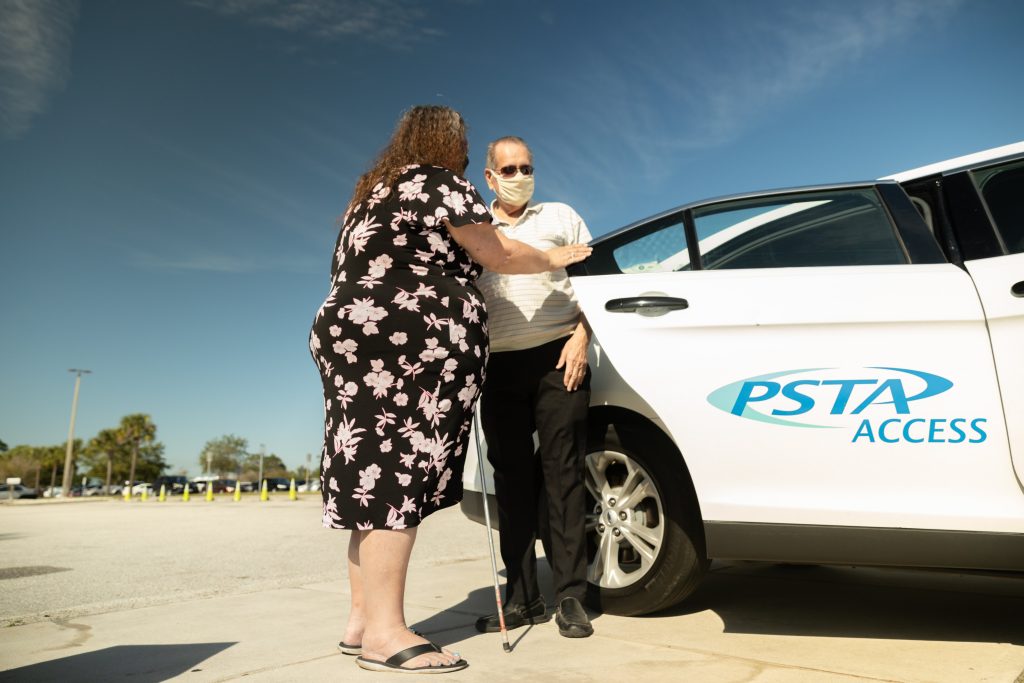
Since its launch, MOD has been wildly successful. In fact, 60% of all Access rides are now taken on MOD. While the reserved Access bus rides are still available for planned outings like doctor’s appointments and the like, MOD provides more freedom for last-minute or unplanned outings. MOD also allows riders to track their rides dispatched through Uber or Lyft. Once an MOD ride is booked, the rider receives a text containing a link they can tap to view their driver’s location through the Uber or Lyft app.
As we discussed in our Deep Drive: All About PSTA Access, MOD does come with a few drawbacks, such as Uber and Lyft drivers not having the same special training as Access bus operators. However, for many, the benefits outweigh the drawbacks. MOD allows riders with disabilities to utilize the same services everyone else does, creating a more equitable option for a population that often faces discrimination or apathy. An MOD ride looks exactly the same as any other ride using Uber or Lyft.
PSTA wasn’t the first transit agency to integrate TNCs into paratransit services—that honor likely goes to Massachusetts Bay Transportation Authority (MBTA) in Boston with their on-demand pilot for RIDE paratransit customers. However, PSTA has positioned itself as a leader in modern paratransit services. PSTA’s MOD program is especially unique in that it does not cap or restrict the number of rides an Access customer can make, allowing them to take total control of their transportation at an affordable cost.
TD Late Shift
As Direct Connect and Mobility-on-Demand were being developed, PSTA staff saw another opportunity to help riders, especially those who qualified for the Transportation Disadvantaged (TD) program. The TD program is a state-funded program that provides reduced-cost transportation throughout Pinellas County to residents who qualify through an application process.
But what about TD riders who needed a ride to or from work outside of normal bus service hours?
In August 2016, PSTA launched TD Late Shift, a program that provides subsidized Uber, Lyft, United Taxi, or Wheelchair Transport rides to TD-qualified riders whose jobs begin or end between 10 pm and 6 am on any day of the week. Such rides are dispatched similarly to Mobility-on-Demand rides, either by calling PSTA or using the PSTA Access app.
The Future of TNCs in Transit
Since 2015, PSTA’s partnership with TNCs has changed the way we support riders who face daily challenges when accessing public transit. Whether someone lives far beyond walking distance from a bus stop, has disabilities that make riding the bus difficult, or faces financial challenges while working the night shift, PSTA has pushed the boundaries of what’s possible to aid riders of all walks of life.

Despite being one of the most underfunded agencies in the country, PSTA has worked hard to do more with less through efficient spending and, most of all, cutting-edge innovation. These days, many transit agencies around the country have similar partnerships with TNCs, and PSTA has proudly been at the forefront of those previously uncharted waters.
As technology improves and the younger generation continues to embrace public transit, TNC-partnered programs like Direct Connect, Mobility-on-Demand, and TD Late Shift are likely to grow in scope and reliability.
In honor of Women’s History Month, we sat down and chatted with some incredible women in transit to learn what transit means to them!
Women have played a huge role in the history of public transit in the United States and continue to shape national policy and lead local public transit agencies. From Sarah B. Owens, the first black female bus operator for DC Transit in 1967, to more recent pioneers like Sharon Cooney, who was recently appointed in 2020 as the first woman CEO in the local transit agency’s history.
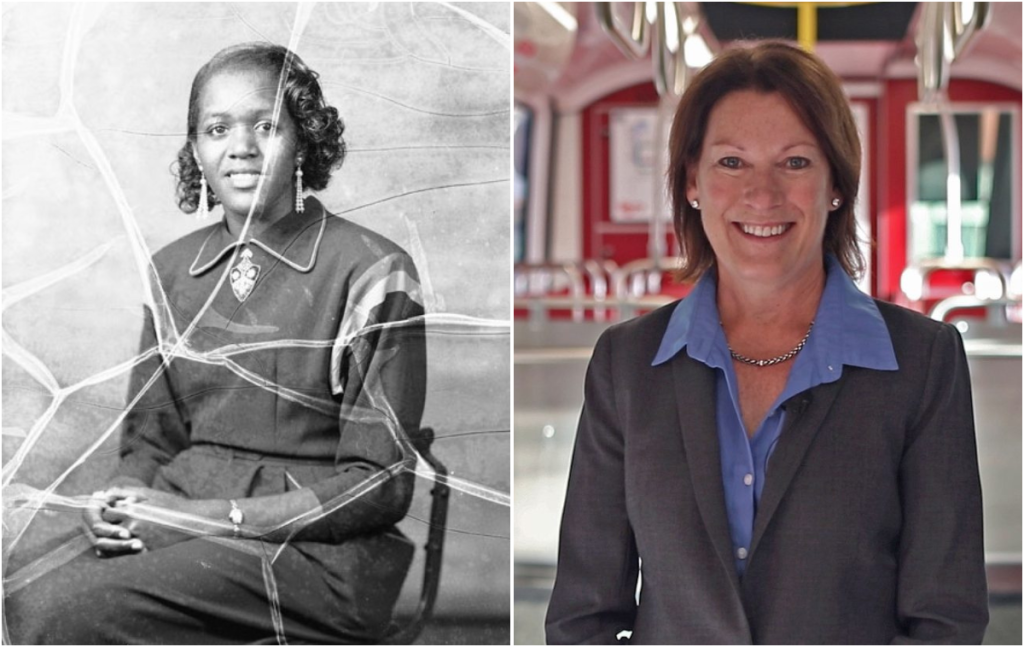
Sarah B. Ownen (left) and Sharon Cooney (right).
To celebrate Women’s History Month at PSTA, we spoke with some amazing women who make our agency the incredible, efficient, and award-winning transit authority we know and love!
Tameka Hubbard, Interim Transportation Supervisor & Bus Operator
Growing up, Tameka didn’t take public transit. Like so many others, she saw buses as an option mainly for those without a vehicle. However, her perspective changed when she began riding PSTA in her late teens. Once she had kids but no vehicle of her own, taking the bus became a godsend for getting to work, running errands, and everything in between.
Tameka’s arrival in the transit world is a bit more recent. In 2021, she decided to join PSTA as a bus operator and will have been with the agency for three years this coming September. What initially drew her to the position was the flexibility such a career would provide her. She wanted to do what was best for her kids and craved a schedule that would allow her to still be a huge part of their lives.
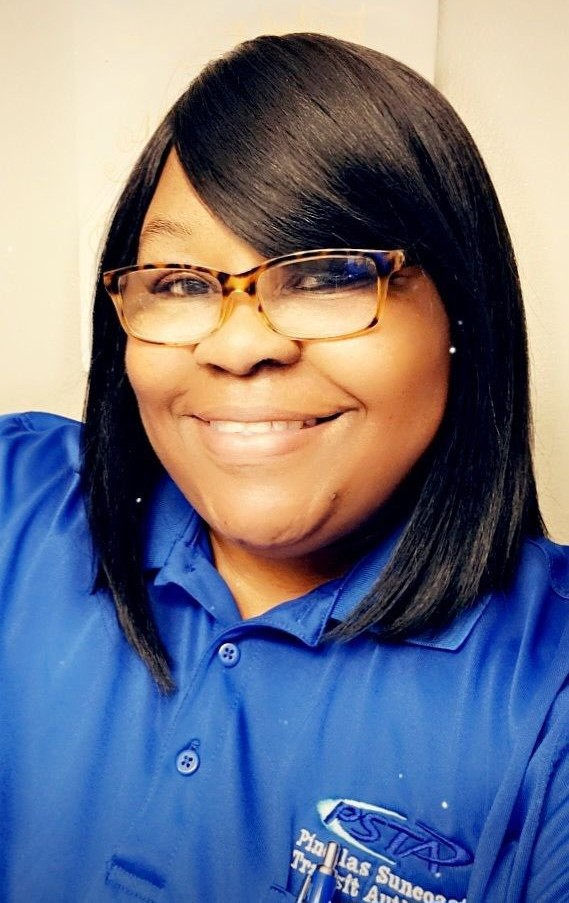
Tameka Hubbard
During her time as a bus operator, Tameka realized she loved driving a bus and the freedom is gave her. Rather than being cramped in an office and feeling closed in, she gets to see the city she loves from the very unique perspective of driving a bus. Each time she drives, she sees places she’s never noticed before—a new restaurant to try out on her day off, a new business to support, a hidden gem to explore. Not only does she enjoy the freedom of driving a bus, but she also loves getting to help people travel to work, school, doctor appointments, hangouts with friends, and more, just as she did when she began riding PSTA.
In her time at PSTA, Tameka has been working her way towards becoming a transportation supervisor, the next milestone in her career in public transit. She now holds the title of Interim Transportation Supervisor, an impressive feat in her first three years!
For Tameka, her favorite part of working in transit, other than the freedom and opportunities to help the community, is the people she works with. “I love my team. It really is like a family environment where we have each other’s backs,” she says with a smile.
We asked Tameka for her perspective on women in transit and she had this to say: “Even though transit has been male-dominated in the past, I’m seeing more women choosing to work in transit each day. I’m seeing more women in positions that have been held by men in the past, so that’s really inspiring. Women are making moves!”
Tiara Holmes, Front Desk Receptionist
Tiara is no stranger to the bus, especially PSTA. Growing up in St. Petersburg, Tiara and her family regularly took the bus, and Tiara herself rode PSTA until graduating from high school. Like many others, she fell into transit by accident as she was looking for a good, stable job after the grind of working in retail. Tiara began working at PSTA in 2018, six years ago now, and she’s never looked back.
One of the first things that surprised her upon starting was learning that PSTA’s service extended to north county cities like Clearwater, Palm Harbor, and Tarpon Springs. As a St. Pete local, she figured most of PSTA’s services were concentrated in south county. As she fell into the rhythm of working in transit, she began to take great pride in helping others.

Tiara Holmes
“One of my favorite things about working in transit is helping riders relocate their lost items,” Tiara says. “People will lose their wallets, phones, and other valuables on the bus—seeing their happiness when those things are returned is amazing. It shows riders that we care and that there are still good people in the world who want to do the right thing.”
Tiara takes great pride in not only reuniting people with their lost things but also helping them better understand PSTA’s services and programs. Providing great customer service is her number one goal as the first face people see when they walk into PSTA’s headquarters.
When it comes to her perspective on women in transit, Tiara is especially excited to see more female bus operators taking on a role that has historically been more commonly staffed by men. She is excited to see more women in these types of roles within transit and looks forward to seeing that diversity continue to grow and improve.
Although she didn’t plan to work in transit, Tiara says she’s eager to continue growing her career within the industry. She’s currently working on developing a career in the Human Resources department so she can help her fellow employees at PSTA—and we can’t wait to see her flourish!
Heather Sobush, Director of Planning
Heather, like many, grew up in an area that didn’t have public transit. In the quiet suburbs of Ponte Vedra Beach, nestled between Jacksonville and St. Augustine, Florida, Heather wouldn’t be exposed to public transit systems until after obtaining her Masters in Business from the University of South Florida.
Her first foray into transit would be through the graduate assistantship she applied for after completing her Master’s coursework, where she worked for the Center for Urban Transit Research (CUTR). What began as simply a desire to find a good job out of college, Heather found herself immersed in her work with the research center as a transportation management associate (TMA), helping large businesses in the area with mobility for their employees through various transit options.
Fully graduated and ready to officially begin her career, Heather was offered a full-time position with CUTR as a Research Associate. She deeply enjoyed the work she did and, after a few years, decided to look for transit work a bit closer to home in Pinellas County. Heather next worked for the Pinellas County Metropolitan Planning Organization (also known as Forward Pinellas), working on planning for local transit and transportation disadvantaged. Her work brought her to PSTA board meetings and had her coordinating with PSTA staff, so it’s no surprise that in 2013, as PSTA was building its in-house planning department, Heather officially joined PSTA staff amidst the Green Light Pinellas referendum.
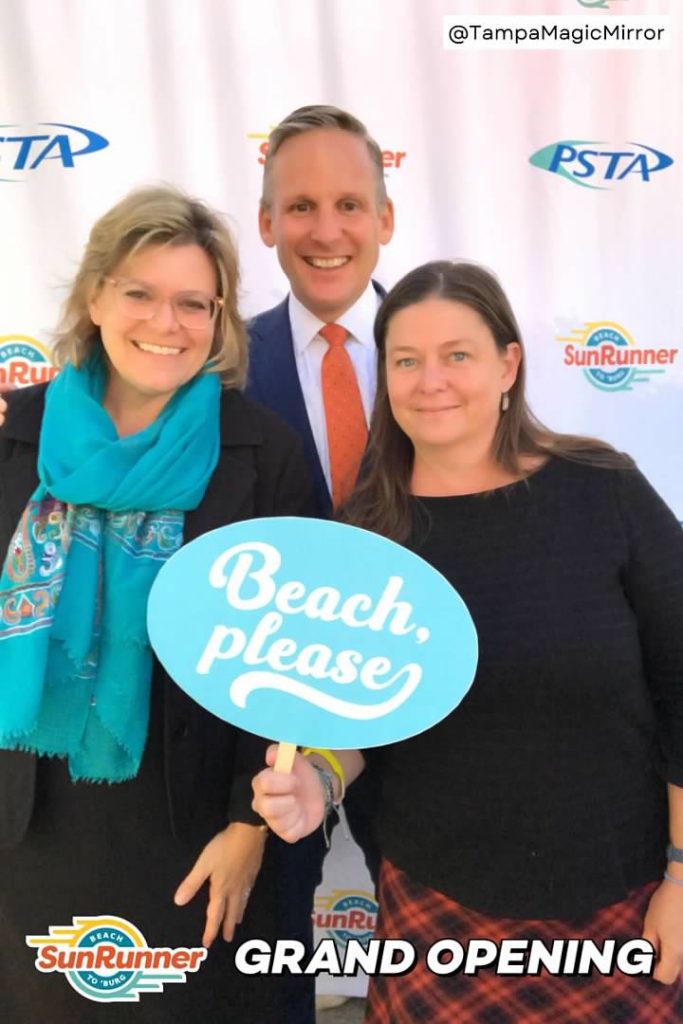
Heather Sobush pictured on the right.
Unsurprisingly, Heather’s favorite part of working in transit is helping to improve the community for a better future. While transit may have been a male-dominated industry in its early days, that has certainly changed.
“Transit becomes more and more diverse each year. Even PSTA itself is extremely diverse in so many ways,” Heather shares.
And for other women who are interested in working in transit, Heather says the door is wide open.
“There is no degree for working in transit, although degrees like urban planning can be really helpful,” she says. “If you’re interested in helping drive progress for your community, transit might be for you! And there’s so many different ways to enter the industry now.”
Although Heather hadn’t planned to work in transit from the start, transit certainly had plans for her, and she wouldn’t have it any other way!
Gina Driscoll, Council Member City of St. Petersburg & PSTA Board of Directors Chairperson
Similarly to Heather, Gina grew up in the small town of Dade City with few public transit options. Like so many others, her first thoughts of transit were that it was only for people who didn’t have a car. Of course, her view has evolved drastically since then.
Gina’s first step into the transit world was through her position on the St. Petersburg City Council representing District 6, which includes downtown St. Petersburg, Tropicana Field, the EDGE District, the Innovation District, parts of South St. Petersburg, and miles of coastal neighborhoods.
During her start on city council, the City of St. Petersburg was launching its bike share program, which would bolster and support local transit by providing first and last-mile options that connected to the bus and trolley systems. Through that project, she quickly realized that she represented a district that heavily relied on the bus, whether for work, school, and errands or for choice riders who navigated downtown with the Downtown Looper and Central Avenue Trolley.
With so many opportunities for better transit in her district, it became clear to Gina that strengthening and collaborating with local public transit was essential. And, most importantly, Gina Driscoll wanted to be on the front lines of that pursuit!
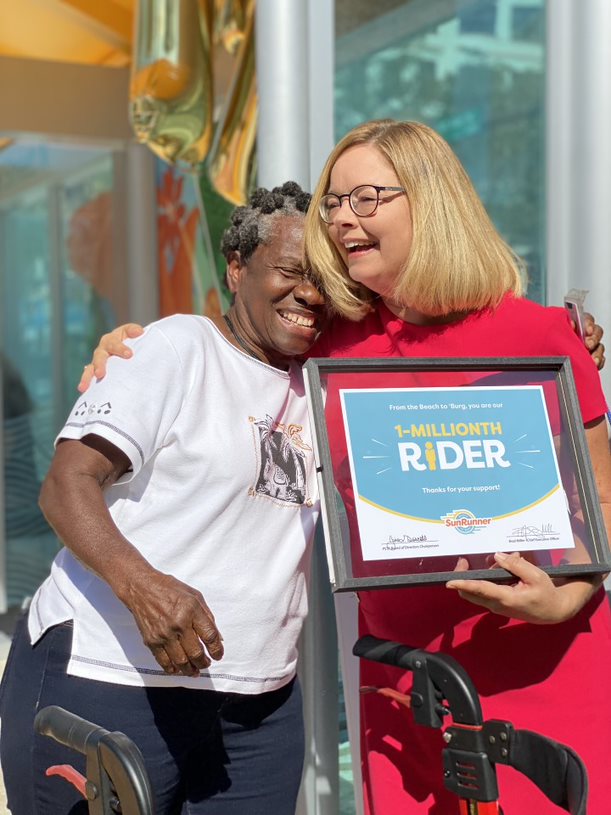
Gina honoring the SunRunner’s one-millionth rider, Geneva Gibbs.
Now during her second term as a City Council member, Gina serves as the chairperson for PSTA’s Board of Directors, allowing her to be intimately involved in collaboration with PSTA. Through her position on PSTA’s Board, Gina helps provide direction to PSTA staff on operational matters, emergency items, and items that will eventually come before the entire Board.
When asked about more women entering the transit space, Gina says, “There’s still a perception that transit is male-dominated, and in some ways it still is, but we’re seeing more and more women rolling up their sleeves. We have more women as operators, technicians, transportation planners, and in leadership positions. It’s encouraging, and I love that we have this representation at PSTA that shows younger women who are thinking about different career options that they can have a great future in transit.”
And for women who are thinking about seeking careers in transit?
“Seek out those women who are making a difference in transit,” Gina recommends, “Call or email them, ask to meet for coffee, and just talk about their experience, how they got into it, and what they love about it. See them as mentors as you explore options for careers in transit.”
It’s clear that Gina takes the improvement and support of public transit extremely seriously and with contagious zeal. And she knows exactly the right words to say to inspire a generation of women to get involved:
“Great cities have great transit. When you look at those great cities with successful, robust transit, you will always find there are women who are making it happen.”
The Future of Women in Transit
It probably goes without saying that the transit world will continue to grow in its diversity and inclusion. In fact, those two words are a big part of PSTA’s Missions Statement and efforts for better Diversity, Equity, and Inclusion. The incredible women featured in this Deep Drive, the many other women who work hard every day to make PSTA the Best Agency in the Nation, and the thousands of women working hard to improve transit around the world all are a vital part of a larger mission—improving communities and the planet we live on.
A huge thank you to Heather, Tiara, Gina, and Tameka for sharing their stories and insights. If you’re feeling inspired to start your career in transit, check out our careers page where we list all open positions.
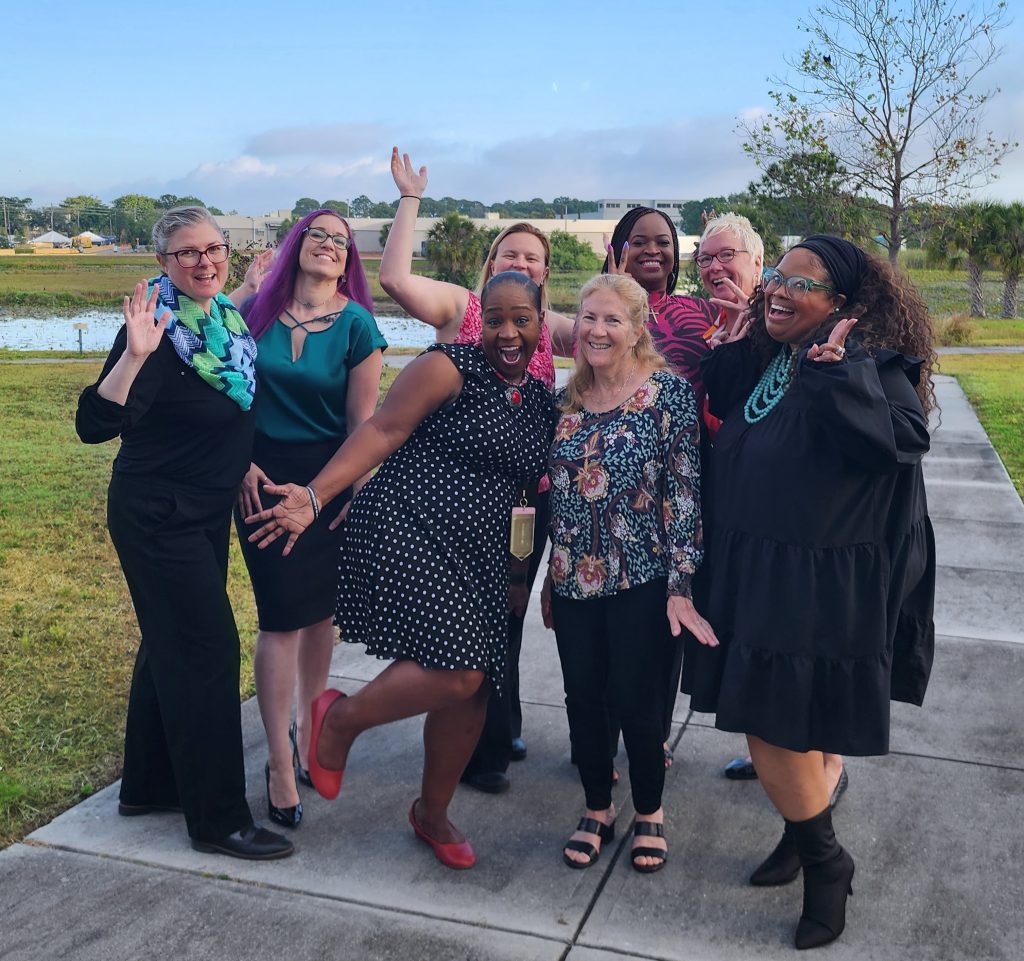
The incredible women of PSTA’s Human Resources team.
St. Pete Beach resident Julia Marchant swears by the SunRunner for her daily commute and weekend fun!
In this next installment of Behind the Wheel, we spoke with avid SunRunner rider Julia Marchant. After all, this series isn’t just a chance to highlight bus operators—we want to spotlight our amazing riders as well!
Thank you to Julia for taking time out of her day to chat with us and tell us all about her love (and her daughter’s love) for the SunRunner.
A Little Bit About Julia
Although born in St. Petersburg, Julia spent her youth in Blue Ridge, Georgia, and would frequently return to visit to help her aunt, who still lived in the St. Pete area and was battling breast cancer at the time. It wasn’t until 2013 that Julia returned, eventually settling down in St. Pete Beach with her husband and, in 2020, welcoming her daughter Emily to the world.
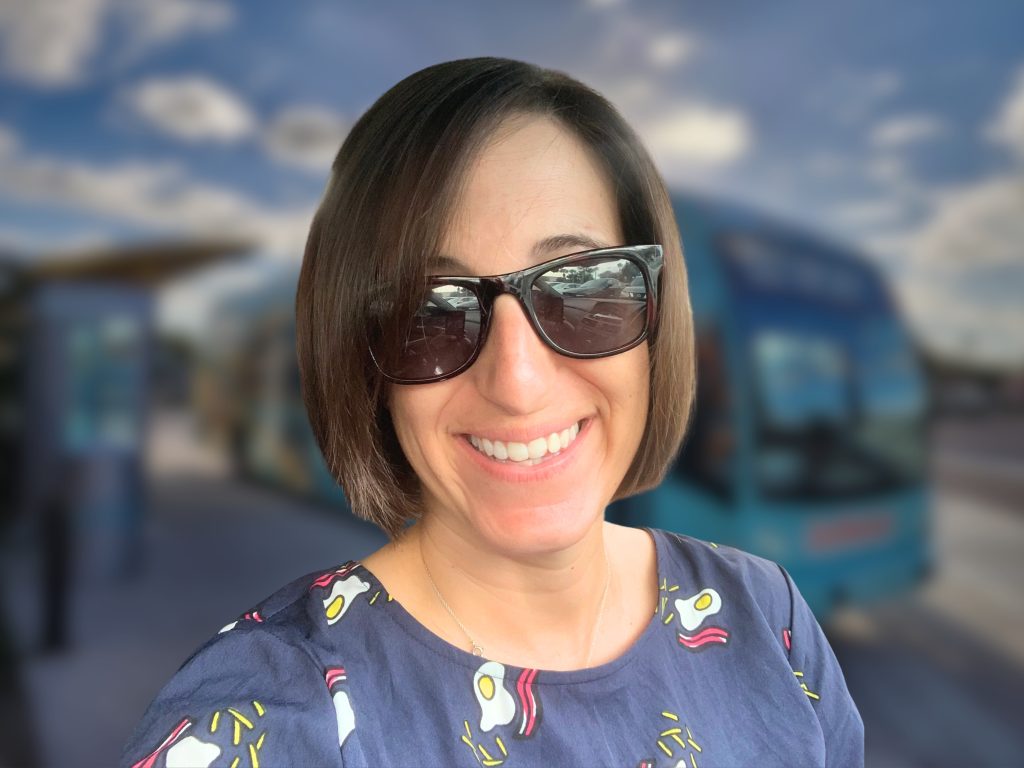
Julia Marchant
By day, Julia works as a paralegal at Weidner Law, but outside of work, she volunteers her time with the non-profit Sea Turtle Trackers as a member of the board and the merchandise coordinator. The organization and its committed volunteers focus on finding, marking, and protecting new sea turtle nests to ensure hatchlings can make it safely to the Gulf.
Discovering the SunRunner
The SunRunner officially launched on October 21st, 2022. But Julia and her family wouldn’t give it a try until December when, on a whim, they decided to try the service and take the bus downtown. What they didn’t know was that the Christmas parade was taking place that evening—an unexpected but wholly welcome surprise for them.
Downtown was packed that night, and the SunRunner was filled to the brim. And although there wasn’t enough room on one of the SunRunner buses for Julia and her family, she was impressed when another bus arrived five minutes later to help with crowding.
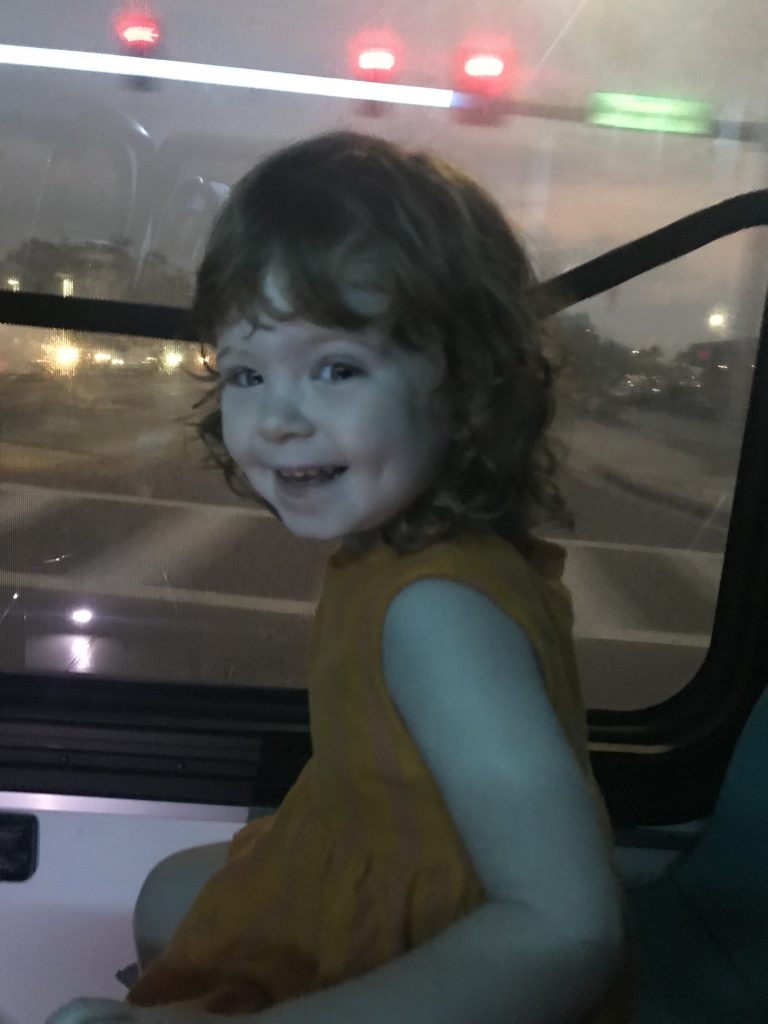
Julia’s daughter, Emily, riding the SunRunner for the first time.
The biggest fan of them all by far was Emily, seen above on her very first SunRunner ride. Little did Julia know, Emily would soon become the SunRunner’s biggest fan and shriek in delight every time she saw it. After such a successful first ride, Julia began to wonder how the SunRunner could be integrated into their daily lives.
Weekday Commutes and Weekend Adventures
Environmental sustainability is important to Julia and her family. Although they already owned an electric vehicle, Julia saw an opportunity to make her commute more sustainable and affordable with the SunRunner. With a SunRunner stop just a short walk from their home in St. Pete Beach, Julia could drop her daughter off at daycare and catch the SunRunner to the stop at 8th Street N. The walk to the stop by her home, combined with the short two-and-a-half block walk to work, gave Julia some good exercise throughout the day—enough to get her heart rate up but short enough to be convenient.
“I don’t arrive at work stressed out and sweaty; instead, I arrive relaxed and ready to take on the day!”
Soon enough, her family found a comfortable routine—her husband would take their electric car to work in Clearwater, and Julia would take the SunRunner.
“I love commuting with the SunRunner because I get some me-time back. I don’t have to worry about driving. Instead, I can check emails, text friends and family, write thank-you notes, scroll social media, or just daydream out the window and enjoy a comfy ride,” Julia said. “Even when the fare-free period ended, I kept riding because I loved the experience, and the fare was still far cheaper than gas.”

Julia and her family with Santa Claus at “Enchant” at Tropicana Field
Julia even uses the SunRunner on weekends. During the holidays, the family took the SunRunner to Tropicana Field for the “Enchant” event being held there. One Saturday in particular, she took Emily to the James Museum for their “Menagerie at the Museum” series featuring mostly indigenous Florida animals. Emily was beside herself when the SunRunner pulled up.
“We’re big fans of Chad Miize’s Mister Sun. Emily gets so excited when she sees the art,” Julia added.

Emily wearing her SunRunner sunglasses and lanyard
A Family of Transit Fans
Julia and her husband have long been big fans of public transit. With her husband being Canadian, they always made a point of taking public transit when visiting his family in Canada. A trip to Europe? They have to check out the trains, buses, and rail lines on offer!
For many, the train systems in Europe are the gold standard of punctual and fine-tuned public transit. For Julia, who has experienced the satisfying efficiency of European transit, the SunRunner is a huge step in the right direction with its frequent buses and real-time arrival information on the bus station totem screens.
We asked Julia what her feelings on public transit were, and it’s clear that she and her family see its value for everyone.
“People have this idea that the bus is only for low-income riders, but I don’t believe that’s true. My husband and I have well-paying jobs and still choose to take public transit whenever we can,” Julia said.
“I know a lot of people are frustrated by the traffic on 1st Avenue and blame the bus lane, but I don’t think the bus lanes have as big an impact as people say—I think the population downtown has just exploded, leading to more people on the road.”
And on the note of SunRunner and its effect on traffic in St. Pete, the Florida Department of Transportation (FDOT) just recently released a study on how the SunRunner has actually improved traffic in South Pasadena.
But back to Julia! Not only does Julia swear by the SunRunner, but she also takes advantage of the other tools PSTA offers for fare payment and navigation.
“I use the Flamingo Fares app to just tap and pay my fare, and I use the Transit app to get around. It’s so easy!”
Missing the SunRunner
Julia is now in the process of moving to Texas, where she was offered a life-changing new job as a federal paralegal. Although she’s currently going back and forth between Texas and Florida as they finalize their big move, she really misses the SunRunner.
“There’s public transit in Texas, of course, but it’s nowhere near as fun or frequent as the SunRunner. I’m really going to miss riding the SunRunner each day. Even now, I ride it whenever I can when I’m back in Florida,” Julia admitted.
As our conversation ended, we asked Julia if there were any parting words she wanted to leave us with, and she had this to say: “I tell everyone I can about the SunRunner. If you’ve never tried it before, I highly recommend giving it a chance because it’s so easy to use, especially the bike racks. Try it on a weekend and see how it goes. I definitely recommend using it for any events downtown, so you don’t have to deal with the stress of finding parking!”
Thank you so much, Julia, for taking time out of your day to tell us about your experience, and good luck with your move to Texas!
If you use any of PSTA’s services and are interested in being featured in our next “Behind the Wheel” installment, email aboisen@psta.net. Want to read our last “Behind the Wheel,” where we featured one of our amazing bus operators? You can read it here!
Let’s dive into the data and see all the different types of people who rely on PSTA—and see the results of our Community Sentiment Survey!
For this month’s installment of Deep Drive, we’re going to dive into exactly who rides PSTA. From students headed to class and employees commuting to work to citizens on their way to doctor’s appointments, hangouts with friends, or running errands, PSTA has the privilege of transporting people from every walk of life imaginable.
If you don’t ride the bus or are new to taking public transit, this Deep Drive will give you a clear, data-driven picture of how diverse PSTA riders truly are!
The Truth About Ridership
First, let’s talk about ridership numbers in general. There’s no question that ridership plummeted during the COVID-19 pandemic, the steep descent beginning in March 2020. Between May and June of 2020, national transit ridership has slowly risen, although it has still not yet returned to pre-pandemic numbers.
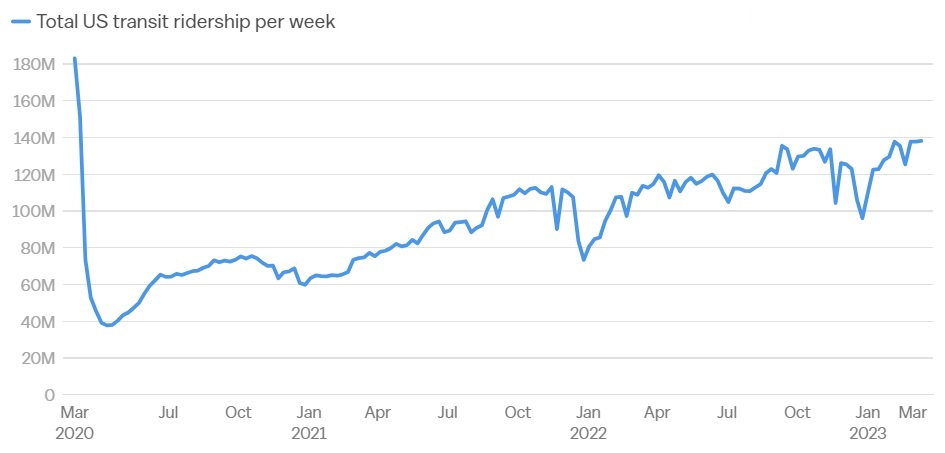
Graph courtesy of American Public Transit Association (APTA)
But what about PSTA, specifically? In PSTA’s 40-year history, the agency’s highest ridership was 14.9 million in the post-recession years of 2014 to 2015. In 2023, PSTA’s latest annual ridership was 10.4 million and rising as riders returned post-pandemic.
In the table below, you can see PSTA’s annual ridership since the agency’s incarnation, as well as how certain events have affected ridership like the 2009 recession and the 2020 pandemic. While that is 30% lower than the 2015 peak, it should be noted that 2023 also saw a 19% increase in ridership during 2022 due to the end of the pandemic and the launch of the new bus rapid transit service, the SunRunner.
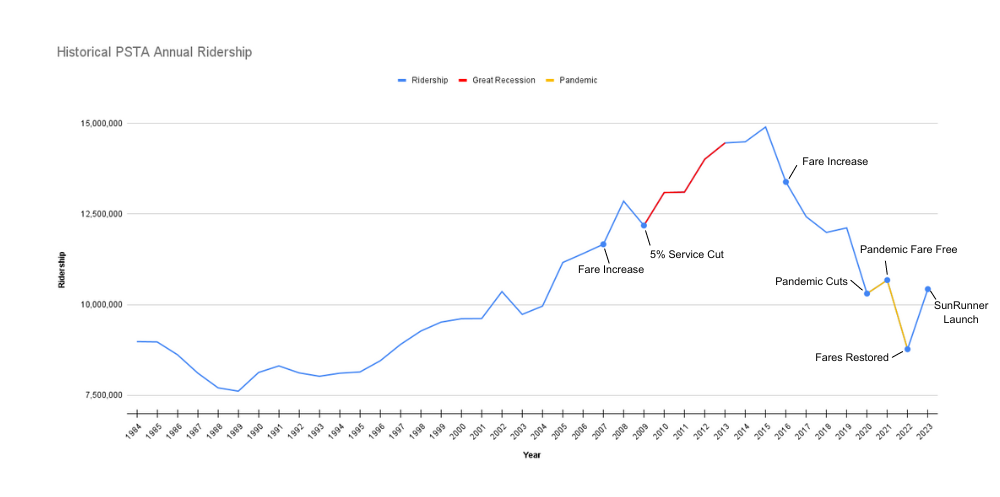
Table showing PSTA’s yearly ridership, 1984–2023
But what’s driving these changes? To put the decline in ridership into context, let’s take a look back at the notable economic conditions of the past 20 or so years.
June 2006:
- Home prices peaked
April 2012:
- Home prices troughed with a total decline of 43.49% in value
- Unemployment: 8.3%
- Unleaded gas prices in Florida: $4.032/gallon
- Median Household Income for Pinellas County: $44,819
- Poverty Rate: 14.1%
- Auto Vehicle Sales (US): 14,433,200
October 2018:
- Home prices returned to prior peak
- Unemployment: 3.4%
- Unleaded gas prices in Florida: $2.834/gallon
- Median Household Income for Pinellas County: $52,226 (average annual inflation 2.84%)
- Poverty Rate: 11.7%
- Auto Vehicle Sales (US): 17,224,900
Compared to 2022:
- Unemployment: 2.1%
- Unleaded gas prices in Florida: $3.021/gallon
- Median Household Income for Pinellas County: $61,851 (average annual inflation 3.27%)
- Poverty Rate: 12.3% (2021)
- Auto Vehicle Sales (US): 13,750,000
Smack in the middle of The Great Recession, 2012 saw declining home prices, high unemployment, lower household income, higher poverty rates, and high gas prices. These factors likely contributed to a steady rise in PSTA ridership from 2009 to 2015, with 2015 being the highest ridership in PSTA’s history.
So, why has ridership declined since 2015? Well, by 2018, the economy had improved significantly with historically low unemployment rates, higher household income, lower poverty rates, and gas prices that were much easier to swallow.
With more money to spend on a personal vehicle since The Great Recession, people have gradually relied on public transit less and therefore, accounts for the steady decline from 2015 to 2019. And then the COVID-19 pandemic hit, throwing every aspect of life into chaos and public transit was certainly not spared.
It’s important to note, however, that both PSTA’s ridership and national ridership are slowly but surely trending upward yet again. Between the slowly recovering post-COVID economy and environmental impacts becoming more prescient in people’s minds than ever, riders are rediscovering the value of public transit—for their own lives and for the environment.
PSTA Rider Basics
With the big picture stuff out of the way, let’s talk data! But don’t worry, this won’t turn into a statistics class. PSTA uses data from its On-Board Bus Survey to get an accurate picture of our current riders so we can anticipate their needs during service changes and to aid us in the development of new programs or routes.
These numbers are based on PSTA’s On-Board Bus Survey conducted on August 18th, 2023, with 6,431 respondents in total.
PSTA Riders by Time of Day
We were able to determine the percentage of riders throughout times of the day, as well as the amount of riders on the weekends.
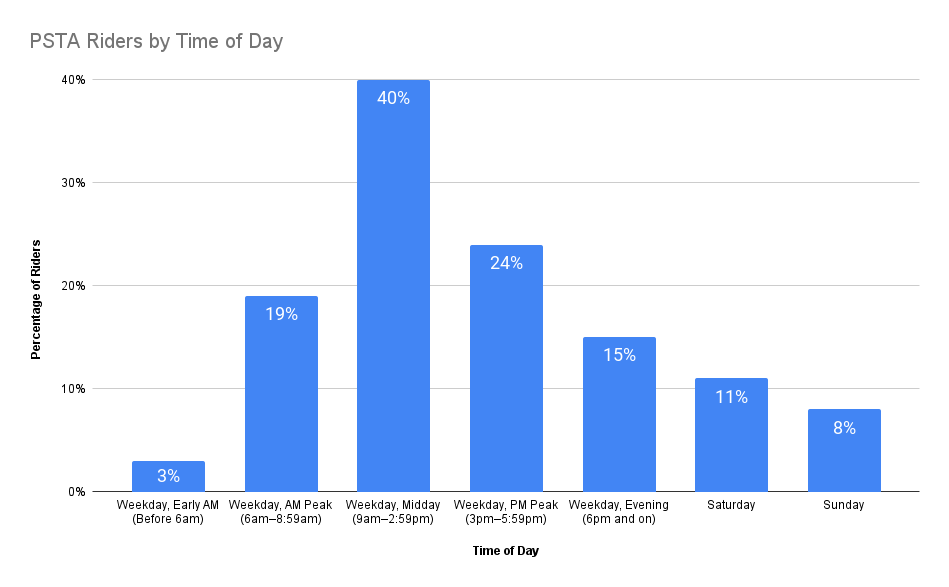
Bar graph showing ridership by time of day
PSTA Riders by Age, Gender and Race
Let’s go over the basic demographics of our riders, specifically the distribution of ages, genders, and race.
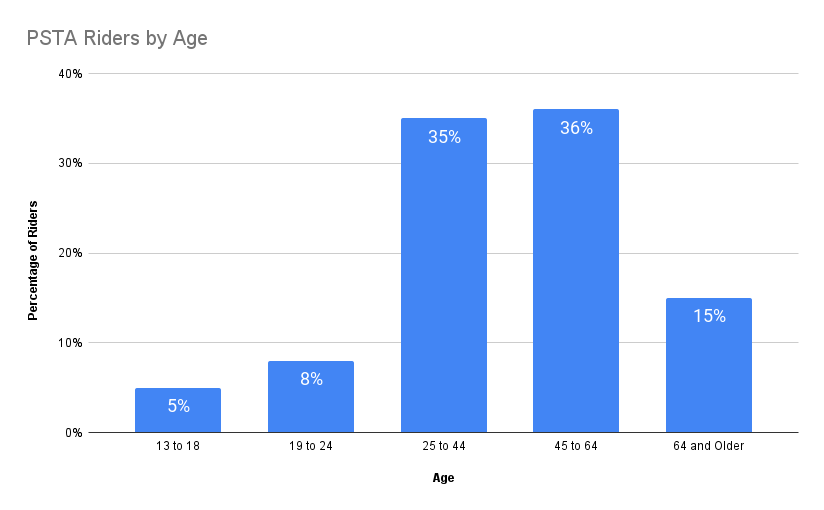
Bar graph showing ridership by age
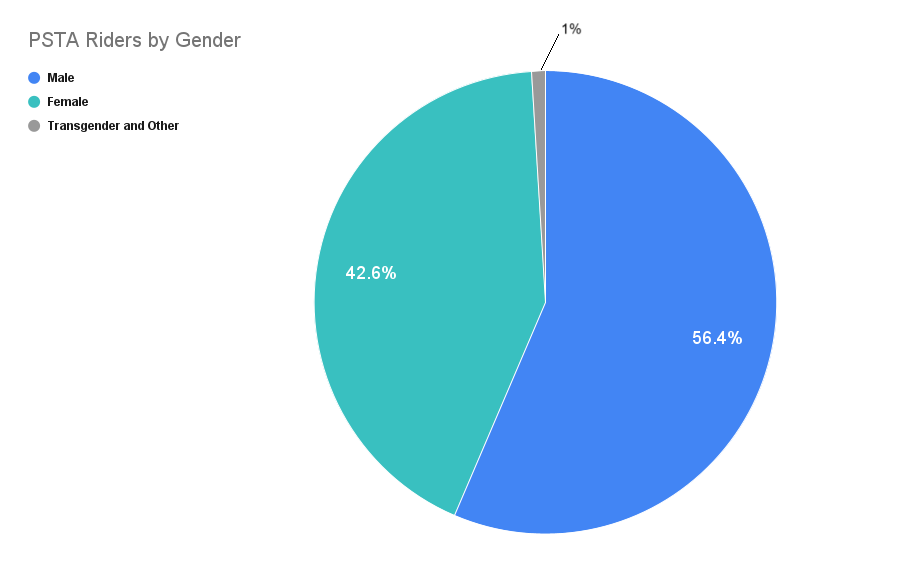
Pie chart showing ridership by gender
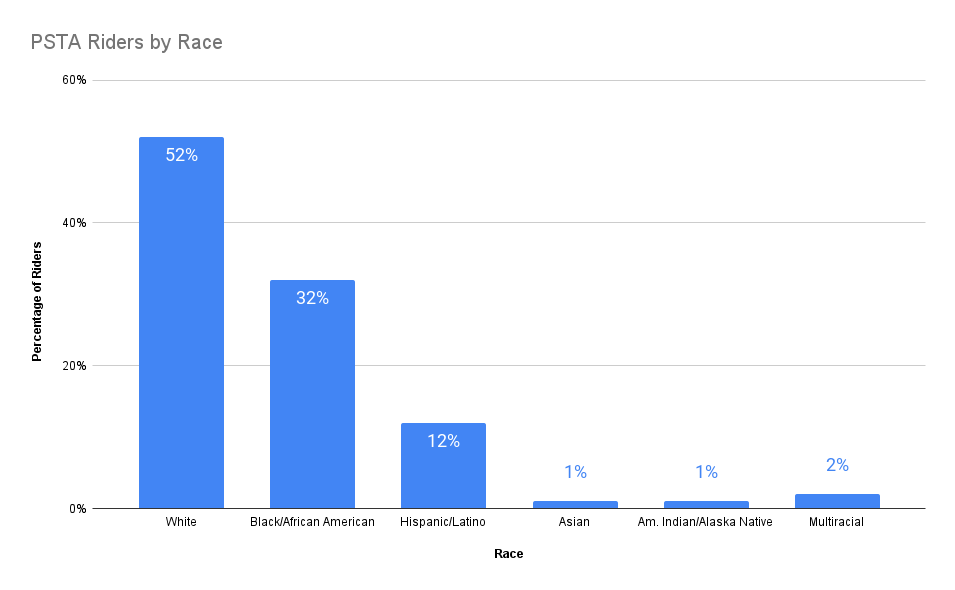
Bar graph showing ridership by race
PSTA Riders by Employment and Income
Public transit is often seen as a service mainly for those of lower income or unemployed. However, this is not the case for many transit authorities, including PSTA. Individuals of all types of employment and income levels rely on PSTA every day.
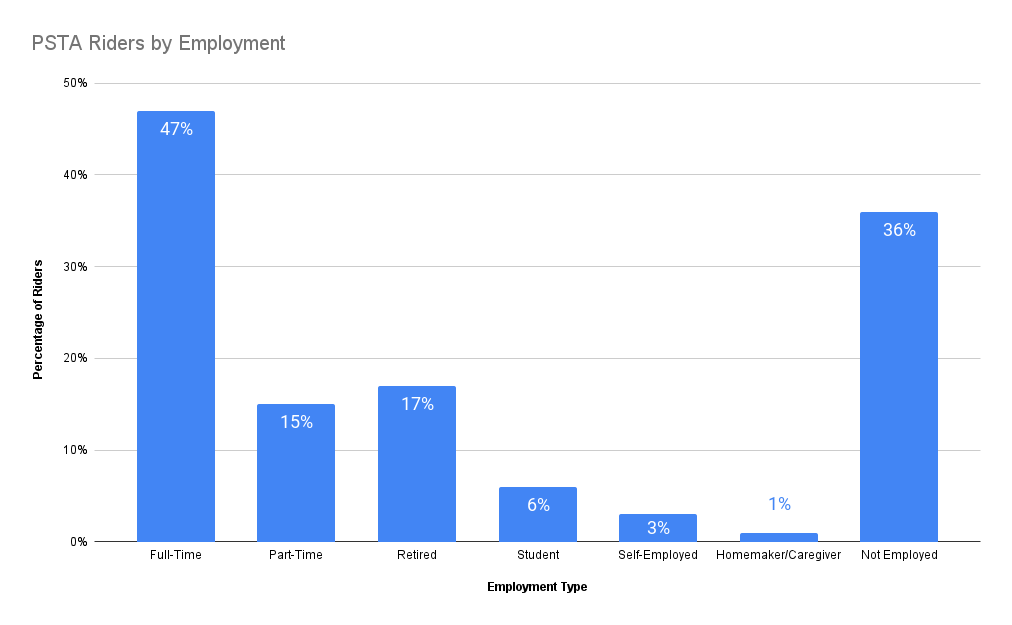
Bar graph showing ridership by employment

Bar graph showing ridership by income
PSTA Riders by Purpose
While discussions around ridership often focus heavily on commuters and students, PSTA riders take the bus for all manner of occasions. We were able to determine the percentage of riders who took the bus for 12 different purposes.

Bar graph showing ridership by purpose
PSTA Student Riders
Although school busing services try their best, some areas lack the bus routes needed to transport grade school students. In addition, college students without vehicles of their own rely on PSTA to leave campus for groceries, doctor’s appointments, and socializing.
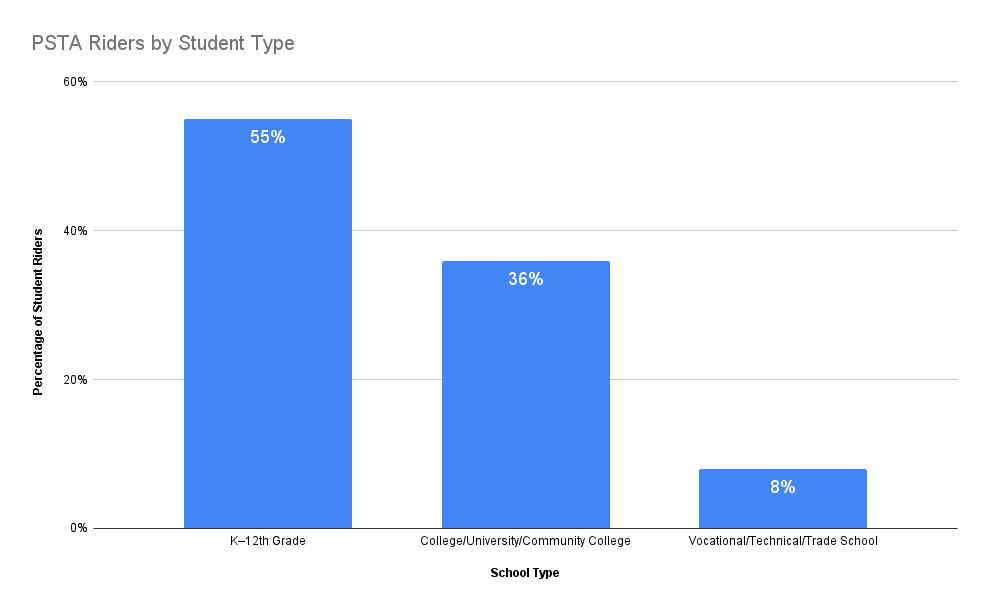
Bar graph showing ridership by student type
Community Sentiment Survey Results
Between March 9, 2023, and April 4, 2023, PSTA conducted a Community Sentiment Survey in order to determine how the community associates PSTA with its intended mission and vision. The data collected will be used to guide future planning, track progress, organizational goals, and strategic planning.
The survey was held via telephone and involved 1,000 non-rider respondents aged 18 and older. Here’s the profile of the survey respondents:
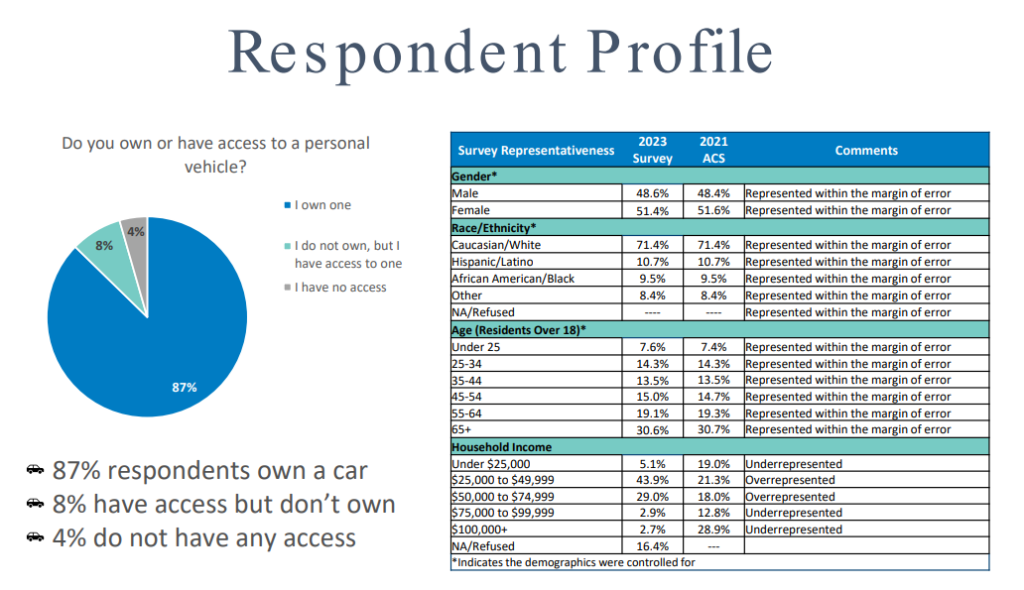
Respondent Profile for the Community Sentiment Survey
Here’s what the community had to say!
Brand Awareness & Community Familiarity
Respondents were first asked how familiar they were with PSTA or Pinellas Suncoast Transit Authority. Results indicate that 89% of respondents could recall Pinellas County’s transit organization by name, 9% could recall the name “PSTA,” and 90% could recall its name being “Pinellas Suncoast Transit Authority.”

Brand Awareness Results From the Community Sentiment Survey
Respondents who were familiar with PSTA were then asked if they had used PSTA and what they associated the organization with. Among those familiar with PSTA, 14% were unsure if they had used PSTA’s services, 37% answered “yes” to using PSTA, and 49% answered “no” to using PSTA.
When asked what things come to mind when thinking of PSTA, the top answers included:
- 51% said “bus company”
- 47% said “public transit”
- 44% said “Pinellas Suncoast Transit Authority”
- 37% said “trolley services”
- 3% said a “general positive comment”
- 0.2% said a “general negative comment”
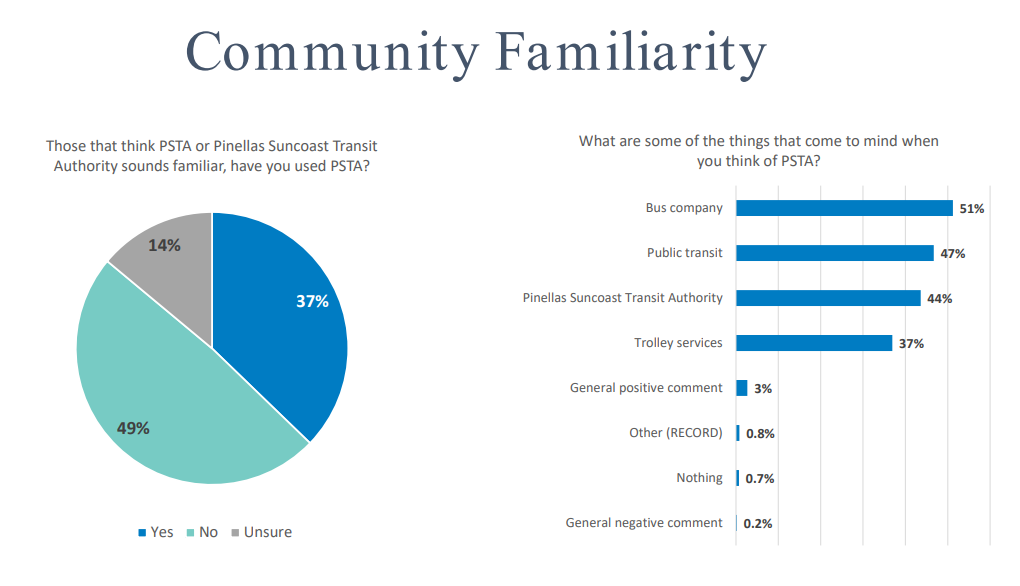
Community Familiarity Results From the Community Sentiment Survey
PSTA also asked respondents if they had heard of the many services, programs, and amenities offered by PSTA, and compared them to data from 2018 and 2019 in the graph below. Awareness of each listed program, service, and amenity has risen significantly since before the pandemic.
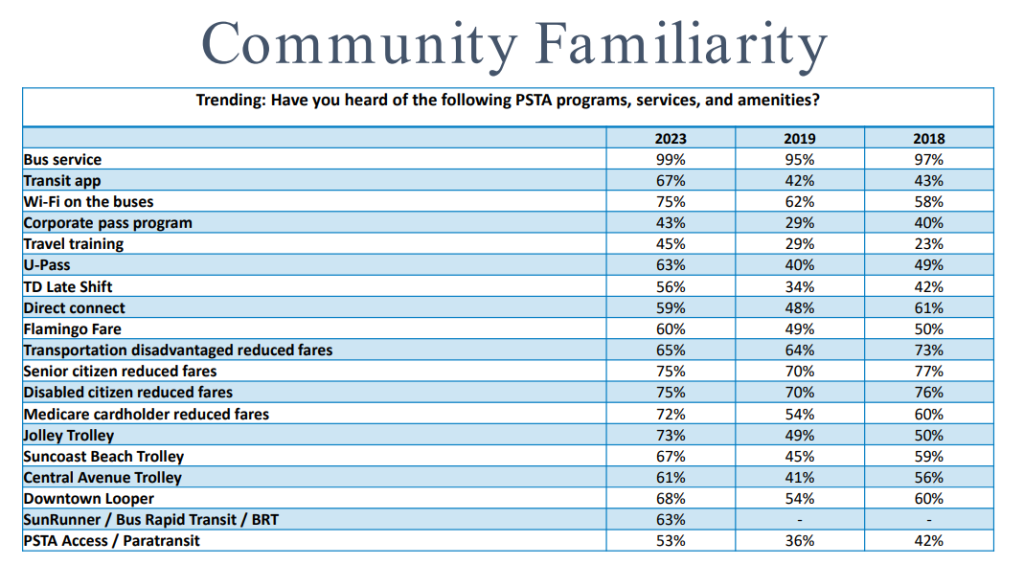
Community Familiarity Results for Programs, Services, and Amenities, From the Community Sentiment Survey
Community Sentiment & Perceived Value
Aside from understanding the level of awareness of PSTA and its services, the heart of this survey was to learn how the community feels about PSTA and how the agency serves the community.
Although the responses indicate mostly positive sentiments with the community, PSTA sees the opportunity for growth among these numbers. In a rapidly changing, post-pandemic world, we seek to keep the community engaged and educated on our essential services and our commitment to diversity, inclusion, and equality.
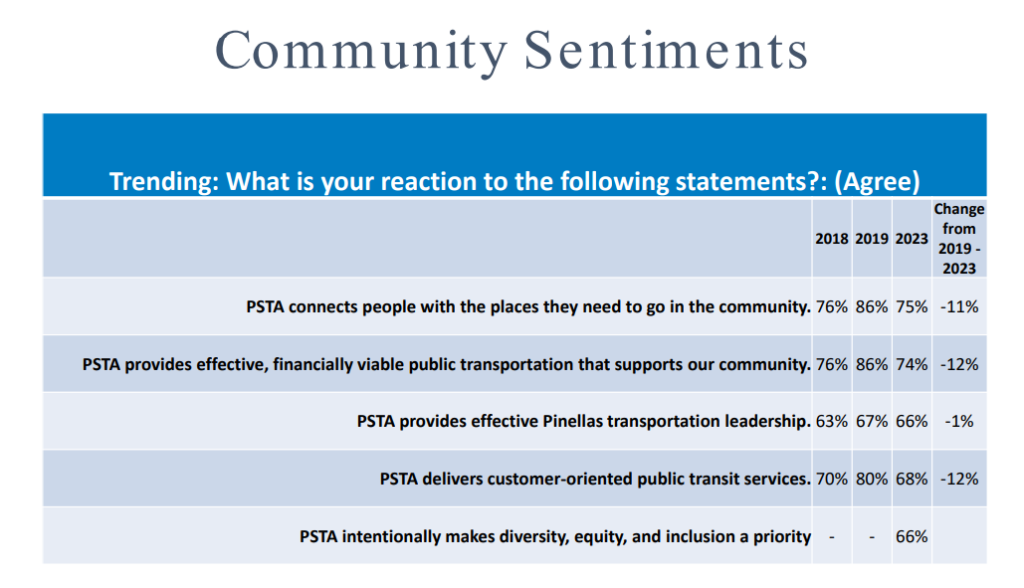
Community Sentiments Results From the Community Sentiment Survey
When asked if PSTA delivers value, the responses were positive and, in some cases, higher than in pre-pandemic years, as seen in the graph below.
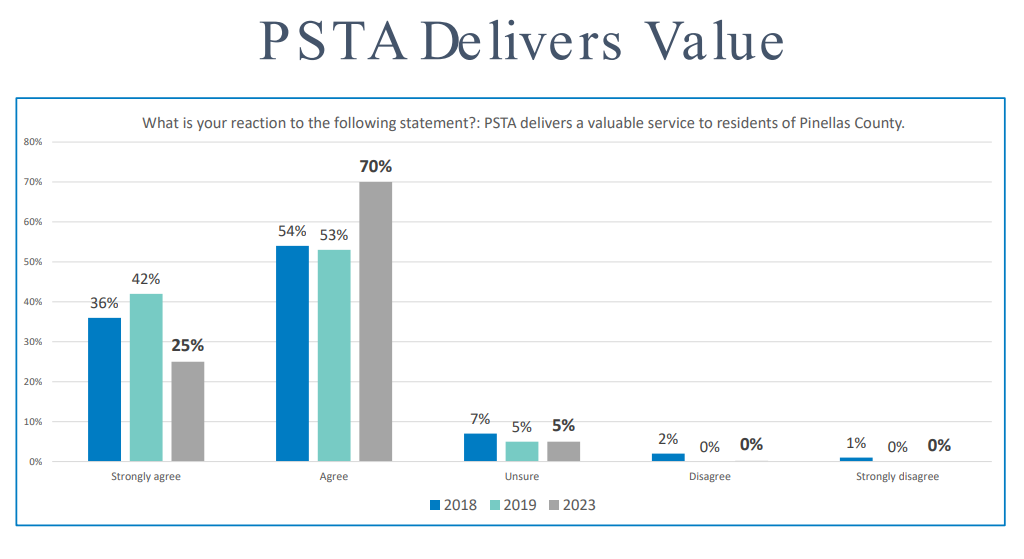
PSTA Delivers Value Results From the Community Sentiment Survey
Funding & Future
In the final portion of the survey, respondents were asked about their sentiments on funding public transit through tax dollars, as well as whether PSTA is adequately funded. An overwhelming majority agree in their support that tax dollars should be used to improve public transit—95% of respondents, to be exact.
In terms of PSTA’s level of funding, there was a marked difference in the response from 2019 to 2023, with more people believing PSTA was adequately funded rather than underfunded.
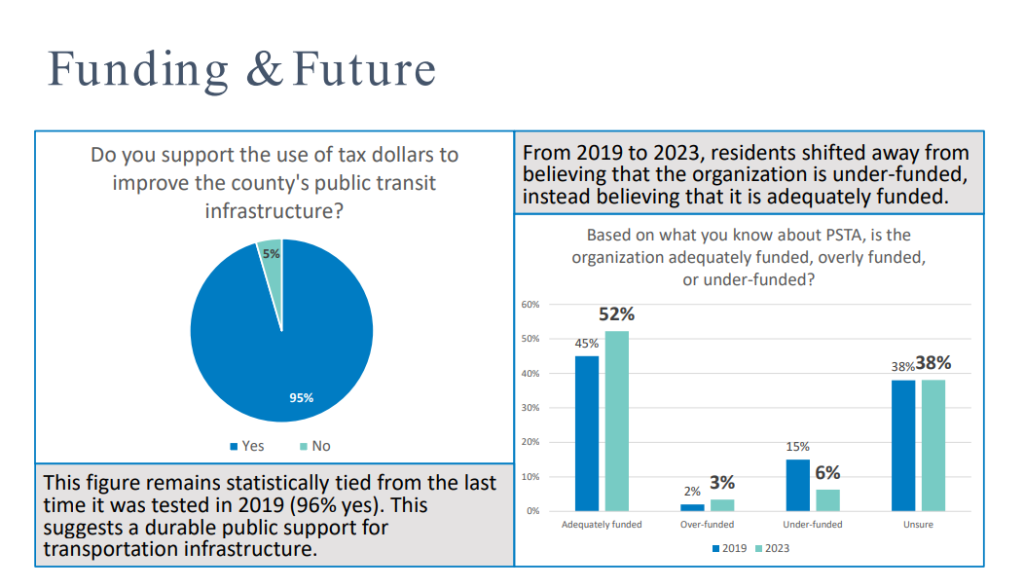
Funding & Future Results From the Community Sentiment Survey
While community sentiment seems to shift to the view that PSTA is adequately funded, the fact remains that PSTA is the least funded transit agency in the state. Despite how efficient PSTA is with the funds it receives, lack of funding has long been at the heart of what holds PSTA back from expanding its services and programs to Pinellas County.
If you’re curious to know just how much funding PSTA actually receives, check out our Deep Drive: How PSTA is Funded and learn more about how property taxes fund PSTA by reading Deep Drive: How Your Property Taxes Move the County Forward.
Welcome to our first installment of a series that will highlight the passionate people who make PSTA amazing!
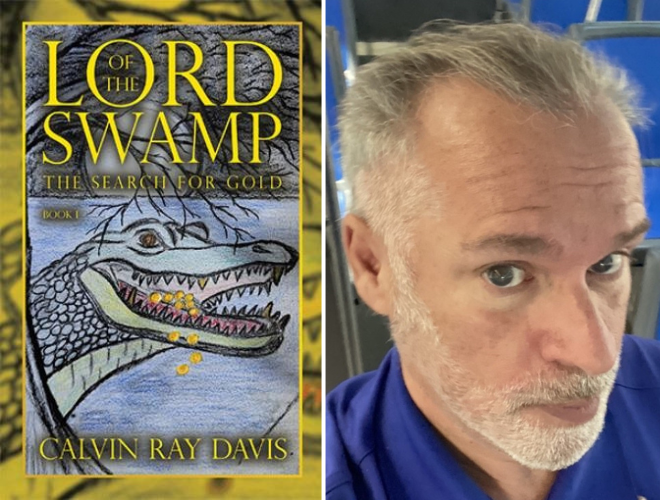
Photo of Calvin Ray Davis alongside the cover of his new book.
Real talk—we have some of the best of the best working at PSTA. While we’ve been diving into complex topics through our “Deep Drive” series, we wanted to create a series that spotlights the individuals who make PSTA the best transit agency in the nation (shameless call back to winning APTA’s Most Outstanding Transit System of 2023).
To kick off this new series of personal stories, we could think of no one better than our multi-talented writer, poet, artist, and bus operator, Calvin Ray Davis!
Artistic Beginnings
Calvin grew up playing in the swamps and bayous of his hometown, Eunice, Louisiana. He and his brothers were dauntless in the face of the snakes, spiders, and other creepy crawlies found in the mysterious bogs—after all, there were adventures to be had and monsters to defeat. And there were certainly plenty of monsters to find considering the rich tapestry of myths so alive in his community. Such creatures were the boogeymen that parents would warn little ones of when they misbehaved.
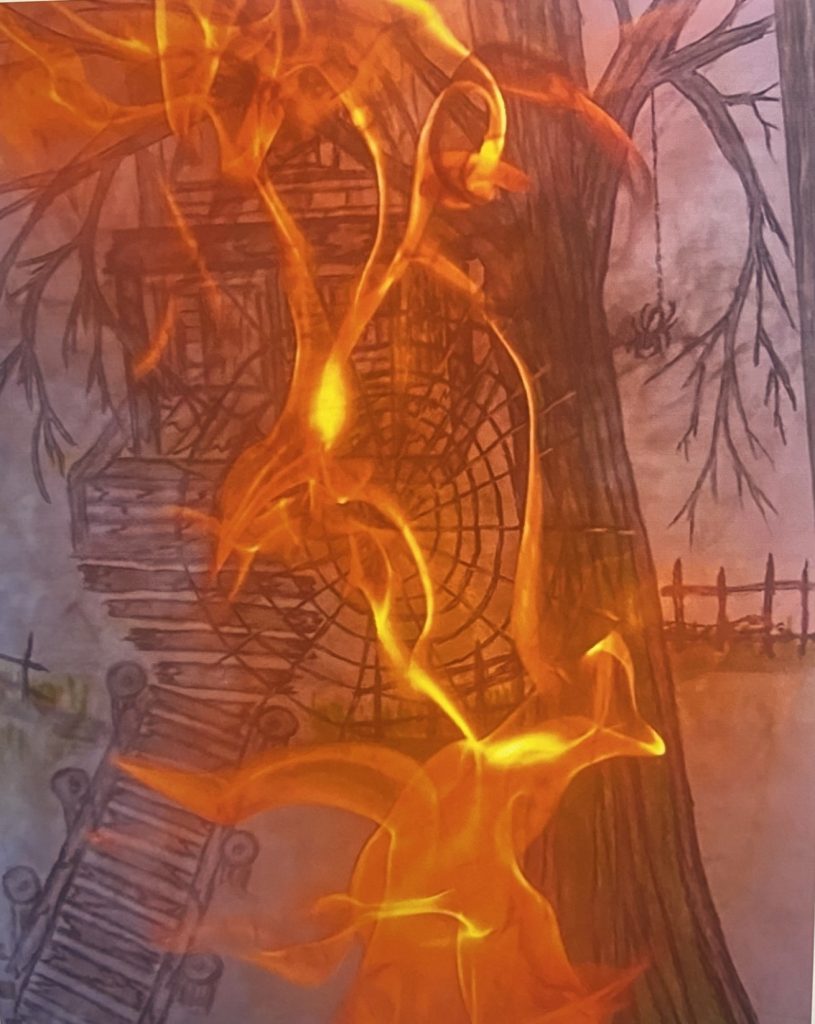
Artwork by Calvin Ray Davis.
With a grandfather steeped in Cajun songwriting and a poet and artist for an aunt, Calvin might have been destined to become an artist in his own right. He began creating art at age 10, writing poetry at age 12, and writing full stories at age 13. In fact, in his recently released novel (don’t worry, we’ll get to that), the first 70 pages were penned when he was only 17.
While Calvin’s childhood was far from idyllic, art was a reliable escape from the tough times. And through this magic-infused setting, abundant in Cajun folklore, it’s no wonder such an upbringing would lead to his new novel, Lord of the Swamp: The Search for Gold.
The Lord of the Swamp Series
Calvin is no stranger to the publishing world; he boasts three previously self-published novels and poetry, was a columnist winner for Colorado Voices, and contributed writing for Firestarter. However, with the September 2023 release of Book One in his Lord of the Swamp series, Calvin taps into the lush landscape of his childhood with a coming-of-age tale about bravery, perseverance, and the unbreakable bonds of brotherhood.
Set in the late 70s, 13-year-old protagonist Ryan spends a summer on a houseboat with an older cousin, deep in the nation’s largest river swamp, the Atchafalaya Basin. The same stories Calvin grew up hearing play pivotal roles in Ryan’s journey in search of a long-lost, sunken pirate ship said to be filled with gold in a remote lagoon. Although the gang encounters expected foes like alligators and snakes, other more fantastical beasts creep into the adventure, namely the legendary Rougarou.

Cover art for Davis’ new book.
The Rougarou is a werewolf myth borne from Cajun and French Canadians, often described as a creature with a human body and the head of a wolf or dog. Although the Rougarou was often used by parents to persuade Cajun children to behave, Calvin’s characterization of this wolfish creature puts a delightful twist on what has historically been a relatively uncomplicated bogeyman figure.
The first 70 pages of this tale were completed when Calvin was 17, which he described almost as a fugue state. “I was just the tool writing the story, and the story demanded to be written,” he recalls. While he took a few years away from writing to start the adventure of life, he would return to Lord of the Swamp while working at PSTA. Again, writing was like a compulsion, allowing Calvin to complete almost all five books in the series within a year.
How PSTA Supports Calvin’s Art
Perhaps one day, we will live in a world where creatives can support themselves solely with their art. But until then, Calvin has always known that working full-time would allow him the stability to continue his art. Early in his career, Calvin left Louisiana for Colorado to start working resort jobs, which allowed him to go on his own adventures and travel around the country. From working at luxury bed and breakfasts to exploring and working at the national parks in California and sleeping under the stars, Calvin got a big taste of all the beauty and excitement America has to offer.
Around age 24, he began driving buses for Beavercreek Transit, navigating the snow and ice of Vail, Colorado. “Compared to the dangers of black ice, driving a bus in sunny Florida is a lot less stressful,” Calvin says, recounting a harrowing story where black ice on a steep slope caused his bus to make an unplanned 180. While all passengers were safe (some even enjoying the unexpected “ride”), Calvin stayed cool under pressure and navigated the vehicle to safety.

Acrylic pour art by Davis.
When he moved to Pinellas County nearly ten years ago, he drove for Uber and Lyft for a time until one day, a passenger recommended he join PSTA. Although he had long let his CDL (Commercial Driver’s License) expire, he was attracted to PSTA due to the in-house CDL certification and the pension. PSTA could help him retire and allow him the freedom to dive into his art.
For five years now, Calvin has balanced his life as a PSTA bus operator and an artist. On days he works the nightshift, he wakes up early to write or paint in the morning before he reports in for work. And like many creatives, he’s also branched into other hobbies like gardening and carpentry.
Calvin believes public transit is an essential service for Pinellas County, and taking the bus is the number one way to lower the number of car accidents. “With onboard Wi-Fi, passengers can spend time on their smartphones without endangering other drivers,” Calvin argues.
Although his heart truly belongs to his writing and art, it’s crystal clear that Calvin takes great pride in what he does. “This book wouldn’t be published without PSTA and the freedom it has allowed me,” he says, “I’m able to do a well-paying job I enjoy that helps the community while also having the time and money to spend on the art I want to make.”
You can purchase Book One of Lord of the Swamp: The Search for Gold at Archway Publishing, Amazon, and everywhere else books are sold. Book Two of Lord of the Swamp is expected to hit shelves in the fall of 2024!
A huge thank you to Calvin Ray Davis for sharing his story and art with us!
PSTA recently had the honor of being named the Most Outstanding Public Transportation System in the Nation—a first in our 39-year history!
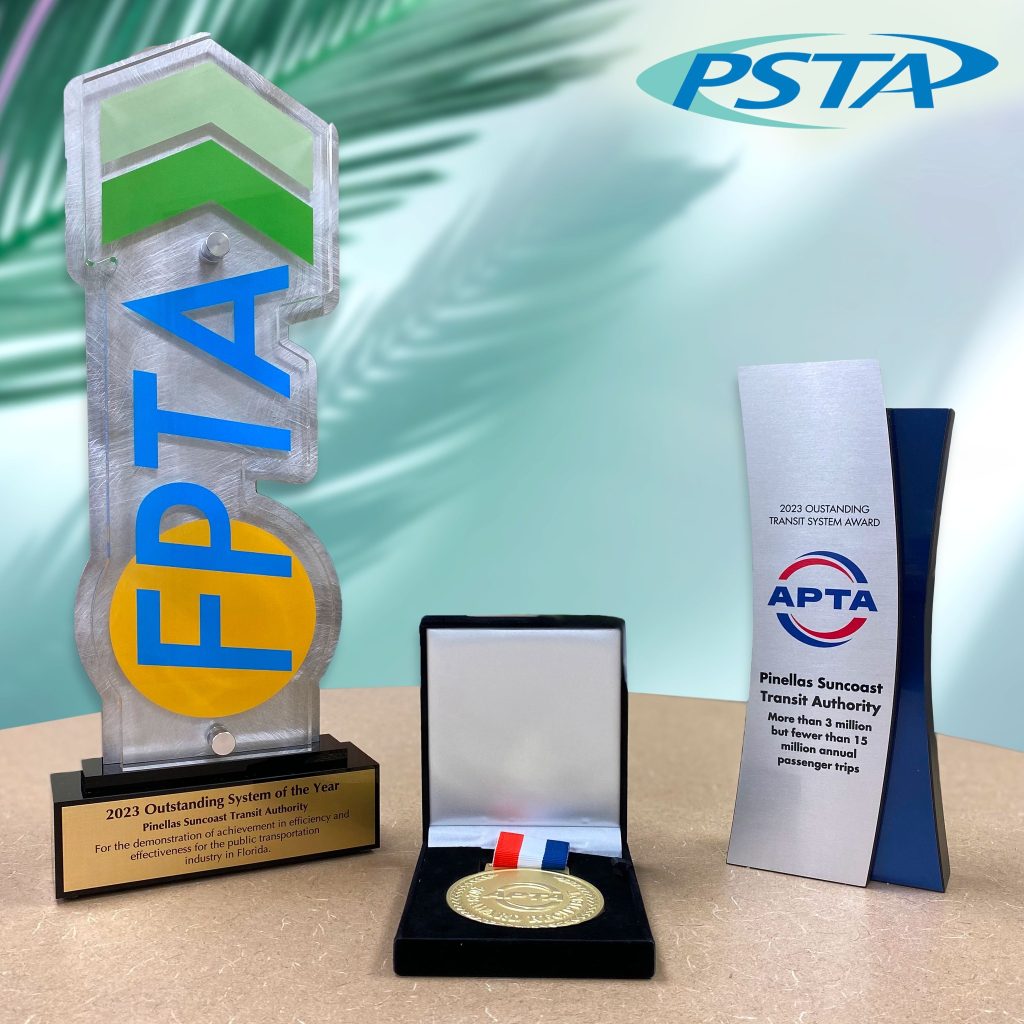
October has brought a whirlwind of awards for PSTA, and we’re excited to share all the good news with you! Between winning the best in the nation and the best in the state, we wanted to show you all the hard work, dedication, and passion our employees have contributed to make these awards possible.
Although the original award submission was over 30,000 words long, we’ll give you the perfect summary. Let’s go over the amazing accomplishments that led to PSTA receiving such honors!
What is APTA and What Award Did PSTA Win?
APTA stands for American Public Transportation Association and is a nonprofit international association of more than 1,500 public and private sector member organizations. APTA is the only association in North America that represents all modes of public transportation, including bus, paratransit, light rail, commuter rail, subways, waterborne services, and intercity and high-speed passenger rail. In fact, more than 90 percent of the people using public transportation in the United States and Canada ride APTA member systems!
Each year, APTA holds its APTA Awards, and PSTA applied specifically for the award titled Outstanding Public Transportation System Over a Three-Year Period. In our application for this award, we presented the accomplishments from 2020, 2021, and 2021. Within our submission, we provided accomplishments related to 12 areas: safety, operations, maintenance, access, customer service, financial management, sustainability, workforce development, marketing, attendance and employee costs, and diversity, inclusion, and equity.
APTA Submission Highlights
Safety
Safety is a top priority for PSTA. PSTA’s Safety, Security & Training department is the only transit authority in Florida that has three Gold Standard Awards, and one of only four transit authorities nationwide with this achievement. During the pandemic, PSTA safeguarded its frontline workers by installing plexiglass barriers to protect drivers. And at the height of the pandemic, PSTA went fare-free (March 2020 to July 2021) to avoid crowds at the fare box and also implemented rear-door boardings only.
Sustainability
PSTA is the leader in moving to an environmentally friendly bus fleet. 14 new electric buses will be added next year, making the fleet 50% clean hybrid-electric and electric vehicles. This move results in better fuel efficiency and reduced greenhouse gas emissions compared to the traditional diesel bus. With the addition of the 14 new electric buses next year, PSTA expects to save more than 172,000 gallons of diesel fuel in 2024.
Customer Service
PSTA doesn’t outsource customer service. All customer service operations are handled in its in-house call center, so riders are speaking directly with representatives who live and work in Pinellas County each time they call, rather than someone who lives out of state or even out of the country.
Operations
PSTA is one of the few transit agencies in the country that is fully staffed with bus operators. This accomplishment is thanks in part to massive efforts in hiring and improving its hiring, training, and onboarding processes.
Workforce Development
PSTA offers an annual year-long leadership development program for high-potential employees, called Leadership PSTA. Each year, the class delivers a project that connects the agency’s public transit services with a community need. PSTA’s 2022 leadership class hosted a community job fair at our transit-accessible main campus, targeting job seekers who ride our buses and employers along our busiest routes.
Oh, and We Won Best in the State, Too!
In addition to winning best in the nation, PSTA also won best in the state! Florida Public Transportation Association, or FPTA, is one of the most active state transit associations in the nation. FTPA’s programs provide over 231 million fixed route trips to Florida residents and visitors, and an additional 11 million paratransit trips.
FPTA named PSTA as Outstanding System of the Year for 2023, as well as awarding PSTA operator Marcus Kincade with 1st place Operator of the Year and PSTA technician Derrick N. Brown with 2nd place Bus Technician of the Year. FPTA also awarded PSTA with 1st place Marketing Award for Electronic Media/TV.
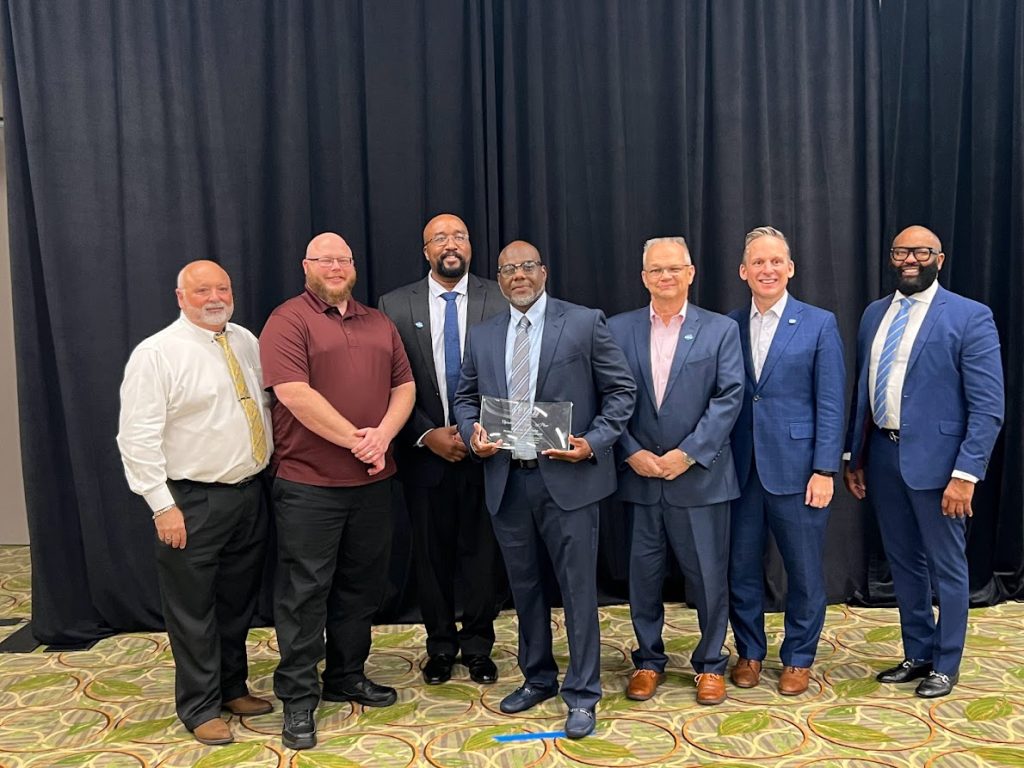

Learn everything you need to know about PSTA fares and how to pay them!
For this installment of Deep Drive, we wanted to explore all there is to know about fares. With the institution of fares on the SunRunner and the elimination of magstripes cards on all PSTA buses, this is the perfect opportunity to refresh current riders and teach new riders how to pay their fare.
We’ll cover everything from how people currently pay to who’s eligible for reduced or free fares. By the end, you’ll have all the information you need to determine what fare payment option works best for you!
Saying Goodbye to Magstripes
Beginning January 2nd, 2024, all PSTA buses will no longer accept magstripe cards (a.k.a GO Cards) for fare payment, nor will they be sold at retail locations or through PSTA’s Customer Service Center.
Make sure to use up all GO Card balances before January 2nd, 2024, as they will not be accepted after this date. There will be no exceptions.
So, what payment option is most similar to GO cards? The Flamingo Fare card and app!
Flamingo Fares allows you to pay using a reloadable smart card or smartphone app. You can also easily manage your balance from the Flamingo Fares app or on your desktop. And the best part: Flamingo cards are tap-enabled. Just place your card over the reader to pay your fare in seconds!
But Flamingo Fares isn’t the only way to pay your fares. Let’s go over every single payment method PSTA offers!
All Fare Payment Methods
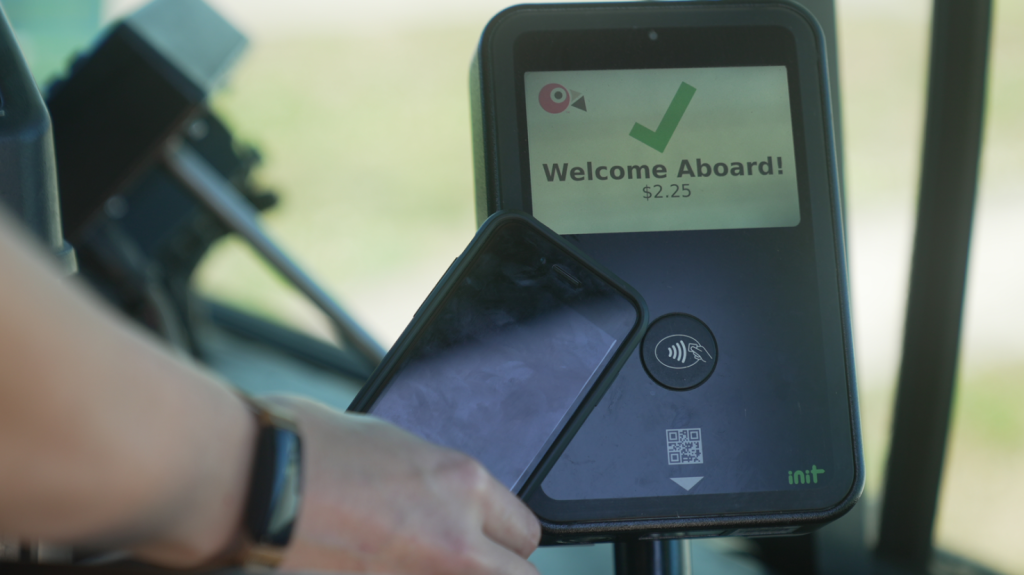
Before we get started, it’s important to note that all the listed payment methods are accepted on all buses with one major exception—the SunRunner CANNOT accept cash. SunRunner riders will instead pay their fares through any of the other methods listed!
On Board
Want to pay your fare as you get on the bus? Whether you’re paying cash through the fare box or tapping your card, here are all the ways to pay!
- Cash: Single Fare—Exact Change (Cash Not Accepted on the SunRunner!)
- Contactless Payments
- Tap-enabled credit and debit cards
- Apple Pay and Google Pay via smartphone or smartwatch
- Flamingo Fares: tap-enabled Flamingo card or app
At Terminals
Like GO Cards, Flamingo Fares cards are available for purchase at any PSTA terminal or Customer Service Center. These cards can be purchased, registered, and reloaded using cash or card, either at a Customer Service Center, online, or via the Flamingo Fares app!
The Flamingo Fares website also shows what terminals are nearest you so you know where to buy your card if you’d like to purchase it in person!
At Retail Network Locations
There are two products available at retail network locations, which can be purchased with cash or any payment method accepted by that store:
- Flamingo Fares Daily Capp ($5): valid for one rider, for one service day. Stops working at the end of the service day following the first tap.
- Flamingo Fares 1-Ride ($2.25): valid for one rider, for one ride. Stops working after one tap.
Participating retail locations in Pinellas County include:
- CVS
- Amscott Financial
- …more to come!
Who Gets a Reduced Fare?
Reduced fares are available to certain riders, such as students not enrolled at a UPASS participating school, seniors over 65, and riders with disabilities.
However, it’s important to note that reduced fares are only available when paying with cash or through registered Flamingo Fares accounts. Onboard the SunRunner, Flamingo Fares is the ONLY way to qualify for a reduced fare.
Individuals Eligible for Reduced Fares
Flamingo Fares is the simplest way to pay for anyone eligible for discounted fares to ensure they will always receive their reduced fare and fare-capping benefits. Visit any PSTA Customer Service Center to have your Flamingo Fares card registered appropriately. Drivers on the bus can’t give discounts to riders using Flamingo Fares.
Contactless payments are planned to become eligible for reduced fares in 2024. In order to receive your discount, you must visit a PSTA Customer Service Center to register your payment method and always use the registered payment method. Drivers on the bus can’t give discounts to riders using contactless payments.
Who Rides for Free?

Certain riders are eligible for free fares either due to their age, status, or thanks to programs through their school or employer.
Individuals Eligible for Free Fares
Universal Pass Program (UPASS)
PSTA’s Universal Pass Program, also called UPASS, allows businesses and nonprofit organizations to pay PSTA an annual discounted rate in exchange for unlimited public transit access for their guests, employees, and/or students.
Current UPASS partners include:
- City of St. Petersburg
- Marriott Sand Key
- MyCRO School
- Opal Sands
- Pinellas County Schools
- Pinellas Technical College (PTC)
- Ready For Life
- Sandpearl
- Sheraton Sand Key
- St. Petersburg College (SPC)
- Tradewinds Resorts
- United Maintenance Company
- University of South Florida St. Pete Campus (USF)
Pinellas County Schools UPASS
Pinellas County Schools is partnering with the Pinellas Suncoast Transit Authority (PSTA) to provide free rides to students and staff through the Universal Pass, or U-PASS, Program!
All Pinellas County Schools students and staff ride free, all of the time! Just display your school or employee ID badge to the PSTA Driver. Substitute teachers display valid ID cards. You may also be asked to verify your identity with a photo ID card.
Learn more about the Pinellas County Schools UPASS program here!
What Is the “Best” Way To Pay My Fare?
The best way to pay your fare will depend on your lifestyle and what method of payment is most convenient for you.
If you prefer to pay with cash, paying your fare with exact change or using a Flamingo Card may be ideal for you. If you love the convenience of tapping with your card or smart device, paying fare with a tap-enabled card or using your phone or wearable is probably your preference.
That being said, here are some pros and cons of each method of payment to keep in mind:
Flamingo Fares: Never pay more than $70/month or $5/day. This is the best value for commuters and regular riders. Reload from your bank account or credit card in the app or with cash at any PSTA Customer Service Center. Your stored value never expires! It is also the simplest way to pay for anyone eligible for reduced fares to ensure they will always receive their discount.
Contactless Payments: Never pay more than $5/day on one payment card. This method is quick and easy for casual riders who use PSTA services fewer than 14 days a month, as well as tourists. Please note that reduced fares are not currently available with contactless payments; this is planned to become available in 2024.
Retail Network: Purchase a daily or single-ride Flamingo Fares limited-use card at a retail network location for $5/day. This method is convenient for visitors to Pinellas County, as well as anyone who prefers to pay cash and does not have a smartphone or regular access to a PSTA Customer Service Center.
Cash on Board: Pay exact change for every bus you board. Pennies are not accepted. This is the least cost-effective option but may be most convenient for those who do not ride frequently.
The Future of Paying Fares
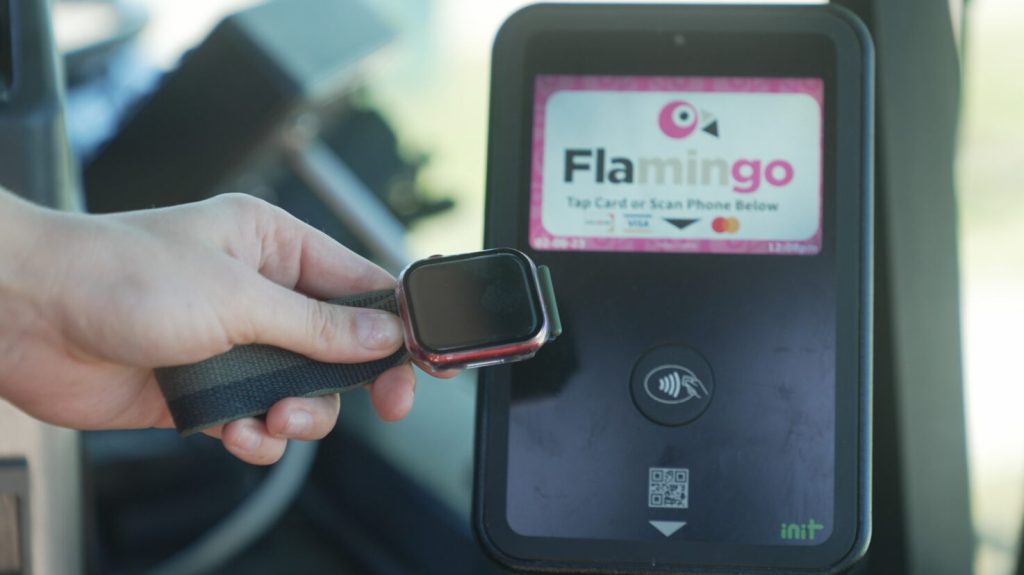
There’s no question that society is moving towards a cashless system where transactions are mainly handled via credit or debit card, or through digital wallets like Apple Pay and Google Pay. That being said, PSTA is very sensitive to the reality that not all riders have access to digital options and has worked to ensure systems like Flamingo Fares are in place for riders who prefer using cash.
Should public transit receive the funding and support it needs, we dream of a day when all public transit is fare-free for all citizens!
With the arrival of Hispanic Heritage Month, we want to spotlight some amazing Hispanic-owned businesses and how PSTA can take you to them.
St. Petersburg
Ceviche | St. Pete
332 Beach Drive NE, St. Petersburg, FL 33701
Whether you’re searching for delicious flavors from our menu or cocktail programs, lively music to get you up & going, or some stimulating time to share with friends, Ceviche brings all these together for you in one authentic experience.
How to get there: Take route 38 to stop 1173 at Beach Dr NE and 5th Ave NE, then walk south two blocks on Beach Dr NE, and Ceviche will be on your right.
Pipo’s—The Original Cuban Cafe
9531 Bay Pines Blvd, St. Petersburg, FL 33708
Over four decades ago, The Hernandez Family opened their first Cuban Cafe in Tampa, Florida. Focused on staying true to the tradition and authentic flavors of Cuban cuisine, they committed to use only quality ingredients and proven family recipes to build their menu. That dedication continues as the Hernandez family delivers authentic Cuban taste to satisfied patrons throughout the Tampa Bay region.
How to get there: Take route 18 or 68 to stop 2379 at Bay Pines Blvd and 95th St N. Pipo’s is right next to the stop.
Red Mesa
4912 4th St. N., St. Petersburg, FL 33703
Open since 1995, Red Mesa continues to bring a wide range of exquisite flavors from all over Latin America to the table, now including a full liquor bar that allows you to enjoy your food with something a little stronger.
How to get there: Take route 4 to stop 2397 at 4th St N and 48th Ave N or stop 2420 at 4th St N and 50th Ave N. Red Mesa is within a block of both stops.
Lolita’s Wine Market
420 22nd Street South, St. Petersburg, FL 33713
Chef Alex Rodriguez and his wife, Kelly moved to St. Petersburg from Miami in 2015. Inspired by their favorite neighborhood spots there, and with a little help from their tenacious rescue pup Lola, they opened Lolita’s Wine Market.
How to get there: Take route 79 to stop 7589 at 5th Ave S and 23rd St S. Lolita’s will be in the old brick train station around the corner to the left of the stop.
Mi Carreta Colombian Restaurant & Bakery
2705 54th Ave N #14, St. Petersburg, FL 33714
A family-owned business with a passion and desire to serve the best Colombian cuisine in the Bay. Known for our authentic dishes, fresh bakery and empanadas, and sensational flavors, come by with your family and friends for breakfast, lunch, and dinner.
How to get there: Take route 11 to stop 2527 at 28th St N and 54th Ave N. Mi Carreta is in the plaza right behind the stop.
Graphi-ko Gallery, Crystals & Jewelry
669 Central Avenue, St. Petersburg, FL 33701
Graphi-ko Gallery is a shop that collects and showcases other local artists, and hosts a new show every month. Wilmer Vergara is the shop owner, and artist creating one-of-a-kind pieces. We hand-make jewelry in shop with gems and leather from around the world. Graphi-ko offers a variety of minerals, crystals, large collection of silver jewelry, and art. Our business is different from other rock shops around because of our Latin flavor and friendly energy.
How to get there: Take the SunRunner to stop 7861 (8th Street Stop) at 1st Ave S and 8th St S. Graphi-ko is one block north on Central Ave, next to Sorrento Sweets.
Clearwater/Largo
Joe’s New York Style Pizzeria and Restaurant
2745 E Bay Dr, Largo, FL 33771
A local favorite pizza joint boasting all the pies, pasta, subs, wings, soups, and salads your heart could desire.
How to get there: Take route 52 to stop 4012 at East Bay Dr and Fulton Dr SE. Joe’s is a block or so to the west.
Southie Coffee
1500 S Missouri Ave, Clearwater, FL 33756
Quality coffee, nitro coffee and lattes, gluten-free pastries, and one-of-a-kind sammys!
How to get there: Take route 18 to stop 4292 at Missouri Ave S and Woodlawn St. Southie is just a block to the south on the right side.
Amaryllis Beauty Salon
1868 Drew St, Clearwater, FL 33765
We have color specialists and master hair designers in a very relaxing area to enjoy great music and a nice complimentary drink!
How to get there: Take route 67 to stop 4647 at Drew St and Corona Ave N. Amaryllis is in the plaza right near the stop.
Panaderia Mi Mexico
1752 Drew St, Clearwater, FL 33755
Try perfectly cooked tamales, pan dulce, and delicious meals at reasonable prices.
How to get there: Take route 67 to stop 4654 at Drew St and Saturn Ave N. Panaderia is just a short walk east from the stop.
La Huasteca Mexican Food & Produce
1745 Drew St, Clearwater, FL 33755
Tienda La Huasteca offers you great dishes of Colombian cuisine. Every time you come here, you see the spectacular service. At this place, guests can enjoy the charming atmosphere.
How to get there: Take route 67 to stop 4660 at Drew St and Saturn Ave N. La Huasteca is just a short walk west from the stop.
Dunedin
Carmelitas Mexican Restaurant
1280 Main Street, Dunedin, FL 34698
Carmelita’s was founded in 1983 by Carmen and Vincent Lopez, with the opening of the Park Street location in St. Petersburg, FL. After 39 years, what started off as just 9 booths have now grown to 5 locations in and around Pinellas County. Step into any Carmelita’s and you will experience the same level of devoted service and the famous recipes that made us one of the most beloved Mexican restaurants in town!
How to get there: Take routes 61, 78, or 813 to stop 5288 at Main St and Lady Marion Ln. Carmelitas is just a short walk east of the stop.
Casa Tina
365 Main Street, Dunedin, FL 34698
Fresh, healthy, authentic Mexican cuisine served by our family and our fabulous staff, as well as our commitment to community giving, makes Casa Tina’s more than just a culinary destination.
How to get there: Take the Jolly Trolley to stop 8048 at Main St and the Pinellas Trail. Casa Tina is right next to the stop.
Los Amigos Dos
404 Patricia Ave, Dunedin, FL 34698
Los Amigos Dos is one of the top Latino grocery stores, taqueria, and carniceria in Dunedin, Florida. For over 16 years, Los Amigos Dos has remained a family-owned business dedicated to providing the highest-quality authentic products.
How to get there: Take routes 61 or 66 to stop 5110 at Patricia Ave and Beltrees St, and you’ll find Los Amigos Dos just north of the stop on your left side.
Juan’s Mexican Grill
1409 Main St, Dunedin, FL 34698
We’re a family-owned and operated business that specializes in Mexican cuisine. Our food is fresh, healthy, and delicious! When people first meet the owner, Mario Constantinou, most like him instantly. He still has a slight accent from his native Cyprus, and he is uncomfortable speaking in public. One-on-one, he’s a warm, engaging individual with a sharp mind and a warm sense of humor.
How to get there: Take routes 78 or 813 to stop 5286 at Main St and Lake Haven Rd; Juan’s is right next to the stop.
Happy Cactus Mexican Cocina
2676 Bayshore Blvd, Ste H, Dunedin, FL 34698
Bringing a little taste of the diverse cuisine from Mexico to Dunedin! Traditional Mexican food.
How to get there: Take route 66 or the Jolley Trolley to stop 5486 at Bayshore Blvd. Happy Cactus is in the large plaza right by the stop.