

Connected Community Bus Network is now live!
See the New Routes
Standard Routes
- Route 4
- Route 5
- Route 9
- Route 11
- Route 16
- Route 18
- Route 19
- Route 20
- Route 22
- Route 24
- Route 29
- Route 34
- Route 38
- Route 49
- Route 52
- Route 54
- Route 58
- Route 59
- Route 60
- Route 61
- Route 62
- Route 65
- Route 66
- Route 70
- Route 73
- Route 74
- Route 78
- Route 90
- Route 91
- Route 100
- Route 203 Skyway Connexion (MCAT)
- Route 300
- Central Avenue Trolley
- Downtown Looper
- East Lake Shuttle
- Jolley Trolley North Beach Route (PSTA passes accepted)
- Jolley Trolley South Beach Route (PSTA passes accepted)
- Jolley Trolley Coastal Route (PSTA passes accepted)
- Suncoast Beach Trolley℠
- SunRunner
- Spark
Regional Express Routes
Trolley Services
Additional Links
Links to Other Systems in the Region
Download the Flamingo Fares App
Available on: Google Play | App Store
Visit FlamingoFares.com for more information.
Below is a list of our most popular fares.
Regular Cash Fare
$2.25
Reduced Cash Fare
$1.10
WHERE'S MY BUS?
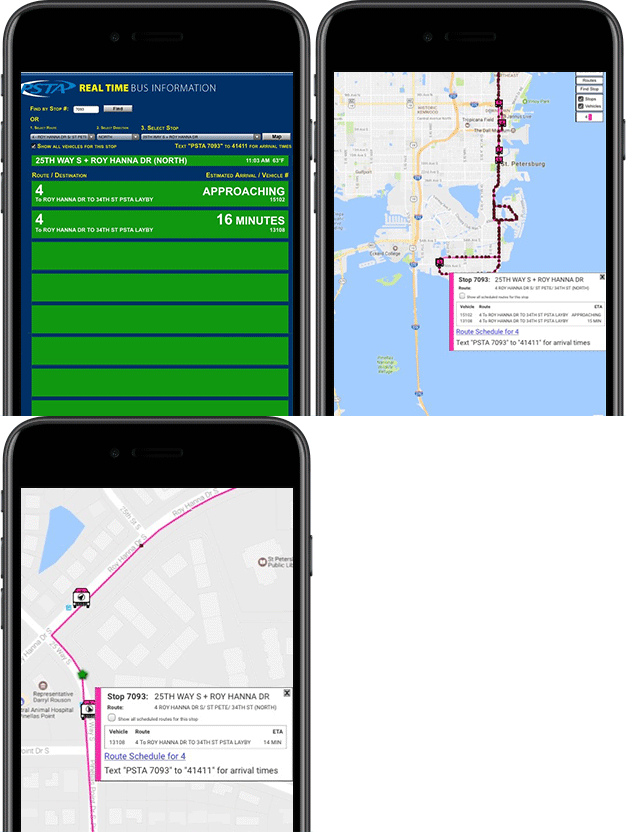
Introducing the Real Time Bus Information.
PSTA invites you to experience Real Time Bus Information. The system works with GPS technology and allows PSTA to pinpoint each vehicles exact location at all times. This means we can provide reliable, real-time departure information to passengers.
November 11, 2025
On September 30, 2025, the U.S. Department of Transportation (USDOT) issued an Interim Final Rule (IFR) modifying Disadvantaged Business Enterprise (DBE) and Airport Concessions DBE (ACDBE) regulations. These changes became effective October 3, 2025.
New procedures have been clarified and are summarized below. This is a follow-up to PSTA’s October 16, 2025 notice.
- All DBE goals have been set to zero until such time our Unified Certification Program (UCP) has completed recertification of all DBEs.
- No DBE participation will be counted towards any contract specific DBE goals.
- UCPs will be providing information on recertification procedures to each current DBE. Please contact the UCP which completed your initial certification directly if you have any questions.
PSTA, based on B2G updates, will once again require prompt pay reporting beginning December 2025 via B2Gnow on current contracts. Although DBE goals and DBE participation data are not being collected for annual reporting purposes, we anticipate this information will become relevant sometime in the near future.
Most of PSTA contracts contain both “DBE” and other subcontractors. By continuing our pay prompt reporting, we can make sure all subcontractors are paid according to our provisions. We will also be using this information as a gateway to our new Small Business Element which we will be implementing.
PSTA will continue to monitor DOT and FDOT updates and provide details via our DBE website and through emails. We are committed always to supporting our small business community.
Welcome to PSTA’s Disadvantaged Business Enterprise (DBE) Program
Pinellas Suncoast Transit Authority (PSTA) has established a Disadvantaged Business Enterprise (DBE) Program in accordance with regulations of the U.S. Department of Transportation (DOT), Title 49 CFR Part 26 and the Interim Final Rule issued October 3, 2025.
One of the major changes to the DBE Program is the removal of race-and sex-based presumptions from the definition of “socially and economically disadvantaged individual." This change requires a reevaluation of all existing DBE firms based on their ability to demonstrate individual disadvantage. Unified Certification Programs will be in contact with the DBEs they certified on how to proceed with this new process.
Program Goals and Objectives
The Department of Justice (DOJ) and Department of Transportation (DOT) have determined: “the use of DBE contract goals in a jurisdiction, where any DBE in that jurisdiction was determined to be eligible based on a race- or sex-based presumption, violates the equal protection component of the Due Process Clause of the Fifth Amendment,” and to “hold and declare that [DOT] may not approve any Federal, State, or local DOT-funded projects with DBE contract goals where any DBE in that jurisdiction was determined to be eligible based on a race- or sex-based presumption.”
PSTA has removed all contract specific DBE goals and counting data from its Vendor Compliance System, B2Gnow until such time the UCP that covers PSTA has completed its reevaluation process. This is complying to changes described in 49 CFR Part § 26.111 – DBE Reevaluation Process.
Eligibility Requirements
A DBE is a small business concern that is at least 51 percent owned by one or more individuals who are both socially and economically disadvantaged. In accordance with new IFR definitions § 26.5:
Socially and economically disadvantaged individual means any individual who is a citizen (or lawfully admitted permanent resident) of the United States and who a certifier finds to be socially and economically disadvantaged on a case-by-case basis. A determination that an individual is socially and economically disadvantaged must not be based in whole or in part on race or sex. For that reason, all applicants shall qualify as socially and economically disadvantaged if they can meet the relevant criteria described in § 26.67. Being born in a particular country does not, standing alone, mean that a person is necessarily socially and economically disadvantaged.
- 26.67 Social and economic disadvantage has been revised as follows:
- Non-presumptive Disadvantage. All applicants must demonstrate social and economic disadvantage (SED) affirmatively based on their own experiences and circumstances within American society, and without regard to race or sex.
1) To satisfy the SED requirement and ensure all determinations of disadvantage are not based in whole or in part on race or sex, an owner must provide the certifier a Personal Narrative (PN) that establishes the existence of disadvantage by a preponderance of the evidence based on individualized proof regarding specific instances of economic hardship, systemic barriers, and denied opportunities that impeded the owner’s progress or success in education, employment, or business, including obtaining financing on terms available to similarly situated, non-disadvantaged persons.
(2) The PN must state how and to what extent the impediments caused the owner economic harm, including a full description of type and magnitude, and must establish the owner is economically disadvantaged in fact relative to similarly situated non-disadvantaged individuals. (3) The owner must attach to the PN a current PNW statement and any other financial information he considers relevant.
PSTA will be monitoring DBE reevaluations and update contract specific goals and counting requirements within its DBE Program in accordance with new IFR compliance. We are also in the process of updating provisions as they pertain to the DBE program and will adjust procurement and goal setting methodologies as well. PSTA will continue to collaborate with regional area small business programs to promote upcoming projects and solicitations.
DBE Program Office Hours
Monday - Friday from 7:30 a.m.- 4:00 p.m.